
1. What was that string of moving lights?
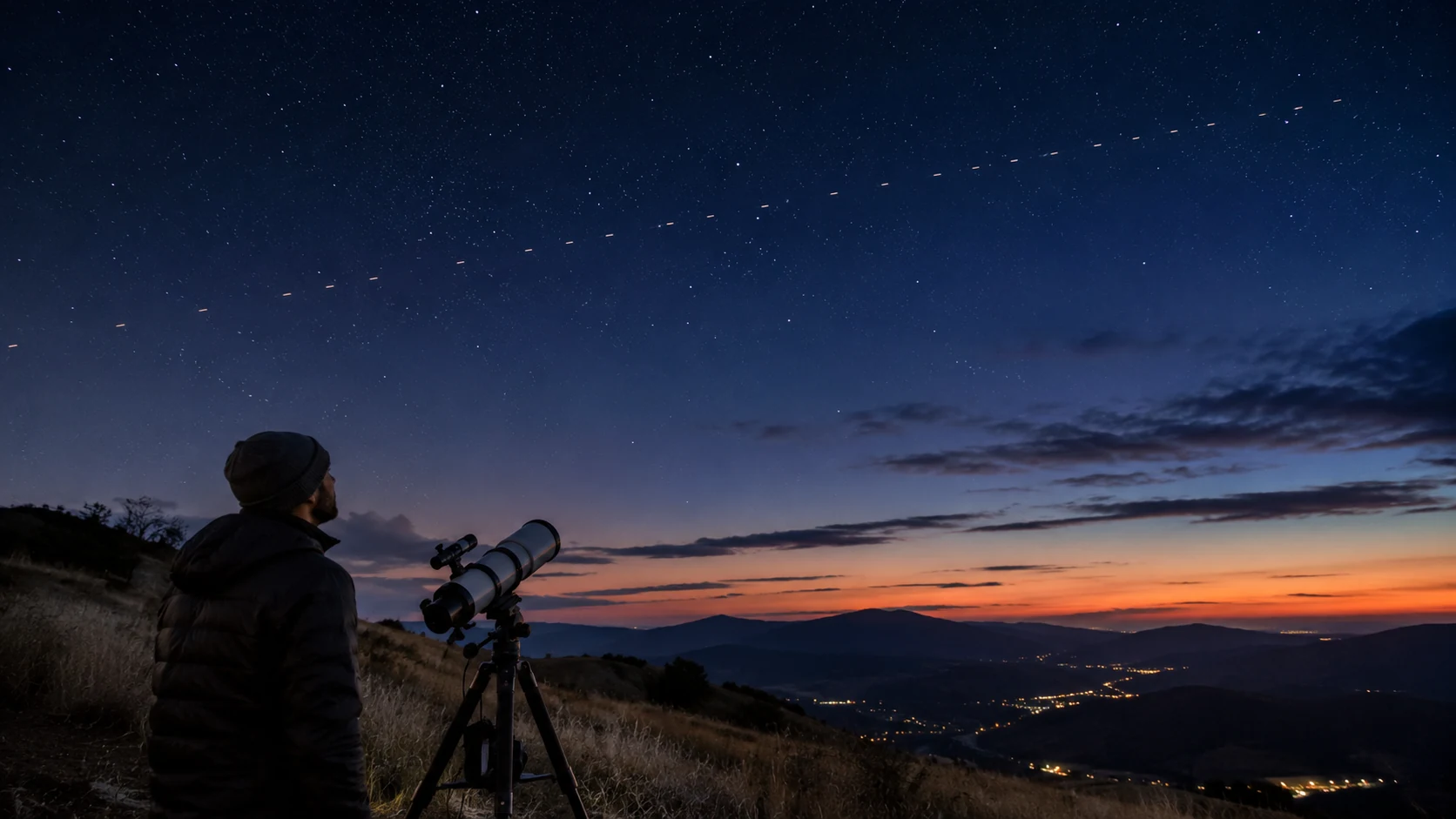
A row of evenly spaced points moving together across a twilight sky can be a newly deployed satellite group. Starlink spacecraft often begin in a relatively compact cluster, then gradually spread along their orbital paths as they maneuver. The points are generally sunlight reflected from spacecraft surfaces, not headlights or visible radio beams. The apparent line is a viewing geometry: the satellites travel along related orbital trajectories, not a rigid physical formation.
Not every moving light is a Starlink satellite. An aircraft can appear as a bright point with blinking navigation lights. A meteor moves rapidly and may leave a short streak. An individual satellite usually moves steadily over tens of seconds or minutes. A high-altitude aircraft or another satellite group can be mistaken for a train, so identification requires time, location, direction and a matching prediction. A social-media clip without those details rarely proves a specific spacecraft identity.
| Observation | Possible explanation | What to check |
|---|---|---|
| Several steady points in a row | Recently deployed satellite group | Recent launches and pass predictions |
| Steady single point crossing sky | Satellite or aircraft | Track, time, blinking, prediction |
| Flash or fast streak lasting seconds | Meteor or glint | Duration and direction |
| Point gradually fades away | Shadow entry or changing reflection | Predicted shadow transition |
| Stationary bright point | Planet, star or distant aircraft | Movement over several minutes |
2. Why twilight is the best time
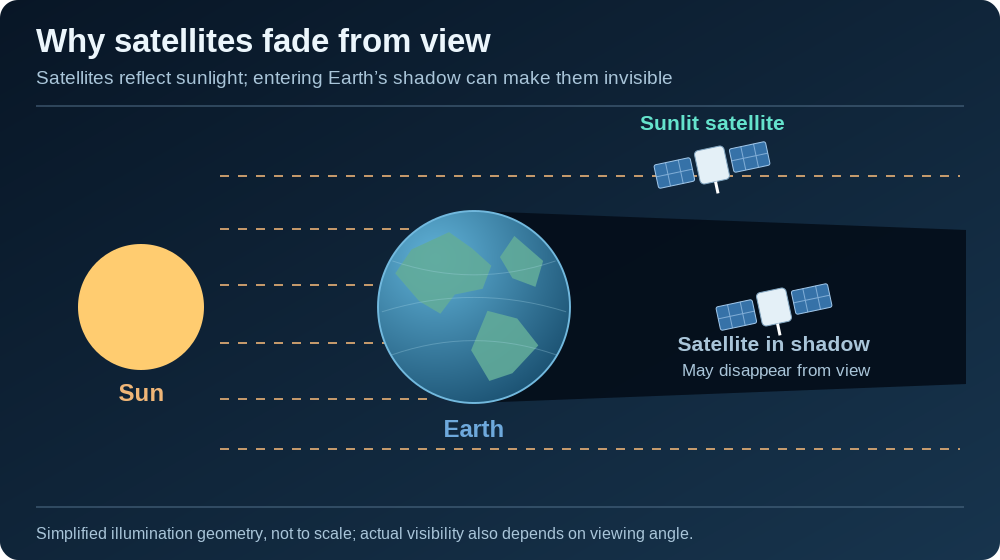
After sunset, an observer on the ground may already be in darkness while a satellite hundreds of kilometers higher still receives sunlight. The dark background increases contrast, making the reflection visible. Eventually the satellite enters Earth's shadow, where direct sunlight is blocked; its reflected light can dim rapidly even though it keeps orbiting and may still carry internet traffic. Before sunrise the reverse can occur.
The geometry varies with season, latitude, orbit and observer position. A satellite may pass overhead but remain invisible because it is in shadow, because the sky is bright, or because its orientation reflects little light toward you. Visibility is not an indicator of whether broadband coverage is available. Radio links and human-visible light are separate phenomena.
3. How fast and high are satellites?
A circular orbit at roughly 550 km above Earth's surface has a representative orbital period close to 96 minutes. Using Earth radius around 6,371 km and standard gravitational parameter 398,600 km³/s², the circular orbital speed is about 7.59 km/s. The actual altitude and inclination of different spacecraft vary. At this speed a spacecraft can pass from one part of the visible sky to another quickly; it does not hover over a home.
The angular rate you see depends on distance and geometry. A nearby overhead pass can appear much faster than one near the horizon. It is incorrect to estimate speed solely from a short phone video without knowing the angular scale, position and range. The engineering guide explains how orbit calculations work.
4. Predict a pass from your location
Use a reputable tracking service such as Heavens-Above or the resources in our viewing guide. Enter your observing location on that service, confirm local time and date, choose a satellite or recent launch group, and check the expected start and end directions and maximum elevation. Compare forecasts with the actual sky and weather. Predictions for newly maneuvering spacecraft can become stale as orbital elements change.
A simple observing plan: choose a safe open location away from traffic; check cloud cover; arrive a few minutes before the prediction; orient using landmarks or a compass; allow eyes to adapt to darkness; record the time, direction and appearance. If you cannot see the pass, note that too. Never trespass or stop on a road to watch the sky. No telescope is required for bright trains, and binoculars may narrow your view too much for a long line.
5. Photograph and identify responsibly
A phone camera may capture only the brightest satellites. Stabilize the camera and use a suitable low-light mode. Long exposures can make a point appear as a streak; distinguish camera effects from actual motion. Record unedited time and direction metadata privately. If sharing an observation online, avoid exposing your precise home coordinates or claiming identification without a matching orbital prediction. An observation journal can be valuable even without a photograph.
6. What happens after the train spreads?
Early deployment is not the final arrangement. Satellites can adjust their orbits, spread in longitude and reach operating shells over time. The initial tight group becomes less obvious to observers. Brightness also changes with altitude, orientation and surface properties. Many individual spacecraft become harder to notice in ordinary skies, but their presence can still affect sensitive astronomical instruments.
A launch count is not the same as satellites currently in orbit, and an in-orbit count is not necessarily an active-service count. Retired spacecraft, failed satellites and those being commissioned may be included in different datasets. Date any constellation number and specify exactly what is being counted. The historical data archive separates manufacturer announcements from external catalog data.
7. Astronomy and environmental trade-offs
Large constellations create useful communications infrastructure and also change the night sky. Bright streaks can affect long-exposure astronomical images; radio transmissions can pose challenges for radio astronomy. Potential mitigations include spacecraft surface treatments, attitude adjustments, coordination with observers and improved observing strategies. Mitigation reduces some effects but does not make every exposure unaffected. The IAU Centre for the Protection of the Dark and Quiet Sky brings attention to both optical and radio impacts. ESA separately studies the orbital debris environment. These are related but distinct issues.
8. Frequently asked questions
Why did the lights suddenly disappear? Often Earth's shadow or a change in reflection geometry, not a failure or a sudden descent.
Are the satellites emitting visible beams? Usually you see reflected sunlight. Communication radio frequencies are outside the range of human vision.
Can I see them every night? A visible pass depends on the observer, orbit, lighting and weather. A prediction does not guarantee visibility.
Does seeing a satellite mean I can buy internet there? No. Service depends on licensing, capacity, hardware and coverage, not on naked-eye visibility.
What happens to satellites at the end of life? Many operators plan disposal or deorbiting; actual orbital lifetime depends on altitude, solar activity and spacecraft condition. See environmental science for the broader issues.
9. Worked example: why a pass can be visible after sunset
Imagine an observer near sunset with the Sun just below the local horizon. A spacecraft at 550 km altitude may still have an unobstructed line of sight to the Sun even though the observer cannot see it directly. If the spacecraft reflects sunlight toward the observer, it appears as a moving point against a darkening background. As it continues around Earth, the planet can block the sunlight, causing the point to fade. In a different pass, a bright reflection can change because the spacecraft's orientation or viewing angle changes. Without orbital information, it is not possible to infer the exact cause of a fade solely from the brightness curve.
10. Build a repeatable observing log
Record date, local time zone, approximate region, starting direction, ending direction, estimated maximum elevation and duration. Note whether the object blinked, whether multiple points followed the same path and whether they faded at similar locations. Compare that record with a current prediction. If there is no match, record the event as unidentified rather than assigning a specific satellite network. Do not publish your exact address or GPS coordinates. The viewing resources provide links to external prediction services, which maintain the orbital data needed for local calculations.
11. Astronomy questions worth exploring
A satellite's apparent brightness depends on distance and how much light it reflects in your direction, not simply its size. A distant object can appear brighter than a nearer one if reflection geometry is favorable. The number of satellites in orbit is also different from the number visible at once: many are on the far side of Earth, below your horizon or in shadow. An observing session is therefore a sample of a much larger moving population. To explore the science, record multiple sessions in different seasons and at different twilight times, then compare the predicted and observed events. For a broad view of the orbital environment, use the historical archive and ESA statistics rather than extrapolating from the number of points in a train.