
Home / Starlink in the night sky
When can I see Starlink satellites tonight?
Updated November 24, 2026 · 4 min read (approx.)
Find predicted satellite passes near your town and learn when, where and how to look for the Starlink train.
In this guide
- Find your next visible pass
- Check a live prediction before going outside
- Choose a suitable observing spot
- Understand the prediction
- Take a photo or watch with children
- How to read a pass prediction
- Why predictions can change
- Get ready to watch
- Evidence and further reading
- Related questions and next steps
- Sources and live resources
- Explore related guides
- Interested in using satellite internet?
Find your next visible pass
Live predictions are provided by an independent external website. Enter your city there.
Check satellite passes near me →Check a live prediction before going outside
Open the viewing tool below, enter your town or coordinates, and choose a predicted pass with good visibility. Note the local time and starting direction. This website does not calculate passes itself or request your location.
Choose a suitable observing spot
A clear view of the indicated horizon is more useful than an expensive telescope. Arrive a few minutes early, let your eyes adjust, and scan the predicted path. Twilight often offers the best contrast between sunlit satellites and the darkening ground.
Understand the prediction
A pass is not a promise of a visible train. Clouds, light pollution, satellite orientation, recent maneuvers and changes in orbital data can affect the result. A low-elevation pass is easily hidden by buildings and trees.
Take a photo or watch with children
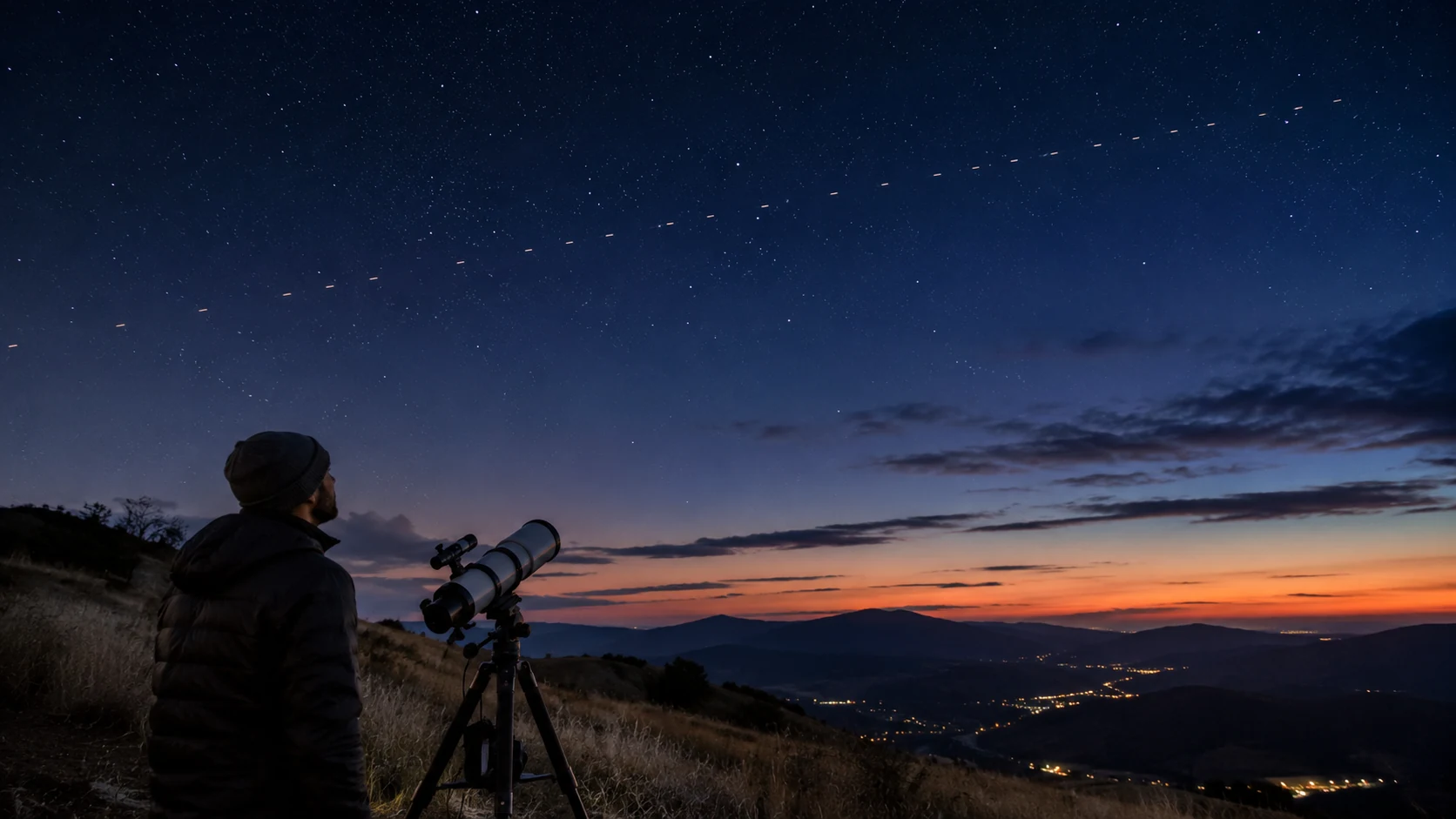
Use a steady support for your phone, turn off the flash and experiment with night mode. A long exposure can make moving objects appear as streaks. For casual watching, your unaided eyes are usually easier to use than a narrow-field telescope.
Reference guide · Updated November 24, 2026
How to read a pass prediction
Predictions usually specify the time an object appears, its direction, maximum elevation and when it disappears. Elevation is the angle above your horizon: zero degrees is the horizon and 90 degrees is straight overhead. A low pass may be hidden by nearby trees or terrain even when the prediction is correct.
Why predictions can change
Recently launched satellites may adjust their orbits, making older orbital elements less accurate. A prediction also depends on illumination and the observer's location; a visible pass from one town may not be visible from another. Clouds, haze and urban lighting can obscure a predicted event.
Get ready to watch
Use a current tracker shortly before going outside, choose a safe viewing location and arrive a few minutes early. Orient yourself using the predicted direction. Do not look toward the Sun with binoculars or telescopes. If you miss the pass, check the next prediction rather than assuming it was cancelled or the satellite failed.
Evidence and further reading
- NASA: Spot the Station FAQ Government science
Explains reflected sunlight and visibility in Earth’s shadow; same illumination principle applies to other satellites.
Sources are linked to original publishers or identified public records. Plan documents and specifications may change. See the research library for evidence types and limitations.
Sources and live resources
- FindStarlink local viewing predictions
- How the prediction service works
- Satellite train observing guide
Guide reviewed November 23, 2026. Live orbital data and service details change.
Explore related guides
- What is that line of moving lights in the sky?
- Starlink, airplanes, meteors or UFOs: how to identify lights in the sky
- How to watch a Starlink rocket launch and satellite deployment
Interested in using satellite internet?
Compare equipment and service costs or learn about referral eligibility before buying.
Planning tools · Dated pricing snapshot · Testing methods
Independent guide. I may receive a reward if you use my referral link and qualify. Not affiliated with Starlink or SpaceX.
Get Starlink $100 Offer ↗Eligible new US customers; two full qualifying billing cycles. Terms apply. Not a checkout discount. We may also receive a reward if you qualify. Offer details.