
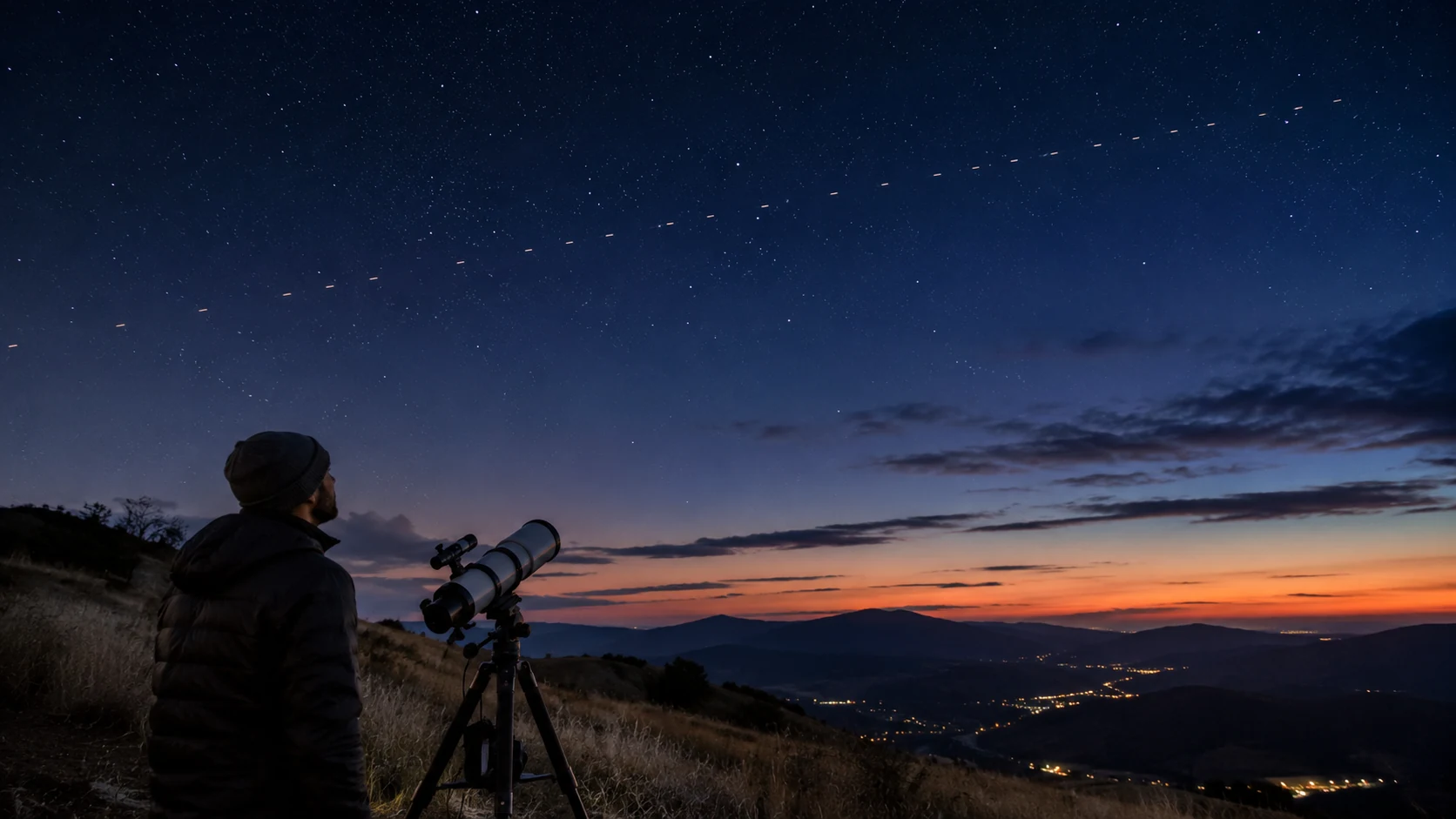
The lights are usually reflected sunlight
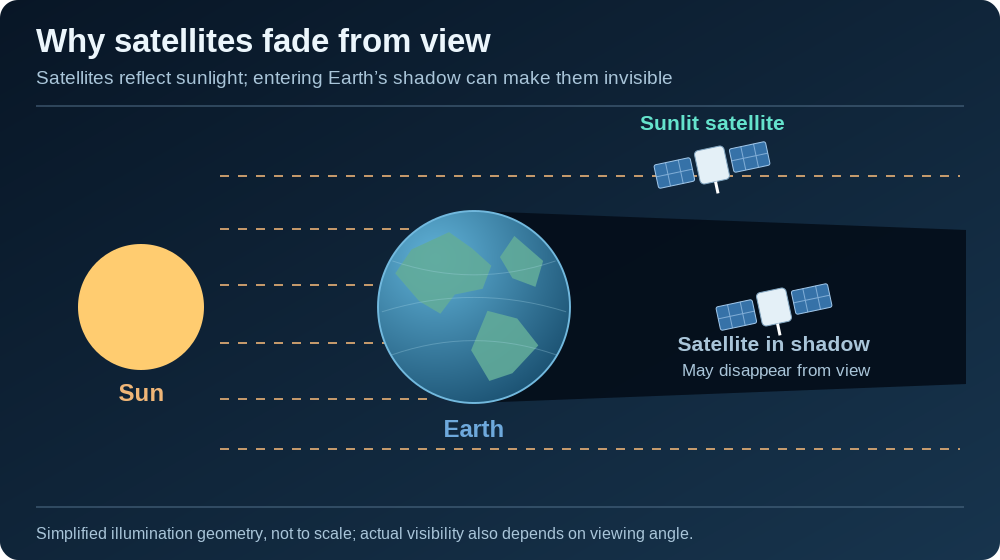
At twilight the ground observer can already be in darkness while an object hundreds of kilometres above Earth remains sunlit. A satellite can look like a moving star because its surfaces reflect some sunlight toward the observer. When it crosses into Earth's shadow, the reflected light can diminish abruptly even though its radio systems and orbital motion continue.
Why an entire train may fade one dot at a time
Recently deployed satellites can be close to one another along a similar orbit. They enter shadow or a less favourable viewing geometry in sequence, so the line may appear to vanish at the same point in the sky. Later, their spacing increases as they move to operational orbital positions.
Earth's full shadow is the umbra; the penumbra is a zone where only part of the Sun is visible. Changes in orientation and reflecting surface can also alter brightness. A satellite's apparent light may vary without any change in its transmission.
How to distinguish several possible causes
| Observation | Possible explanation |
|---|---|
| Steady moving dots fade at a common place | Orbital shadow boundary or viewing geometry |
| Repeating red/green/white flashes | More consistent with an aircraft; not conclusive |
| Fast streak lasting seconds | Possible meteor |
| Several different stars fade together | Cloud or haze may obscure them |
Try this observation yourself
- Note date, local time including time zone, approximate location and direction of travel.
- Use a satellite-pass prediction service and compare its times and directions with your observation.
- Choose a dark location with an open horizon and safe footing. Watch several minutes before the predicted pass.
- Record whether the lights disappear progressively or all at once. Do not rely on an old prediction after an orbital maneuver.
Does disappearance mean the internet went down?
No. An optical sighting is not a measure of the radio network. Satellites can operate in Earth's shadow using onboard electrical energy. NASA explains the same reflected-sunlight principle for the International Space Station; Starlink satellites are different objects, but the illumination geometry is shared.