
Home / Starlink in the night sky
Starlink, airplanes, meteors or UFOs: how to identify lights in the sky
Updated November 24, 2026 · 3 min read (approx.)
Compare common night-sky sightings before deciding whether an unfamiliar light is a satellite.
In this guide
- A satellite train
- Aircraft and drones
- Meteors and reentries
- When the object remains unidentified
- Use a simple observation checklist
- Verify with time and location
- Evidence and further reading
- Related questions and next steps
- Sources and live resources
- Explore related guides
- Interested in using satellite internet?
A satellite train
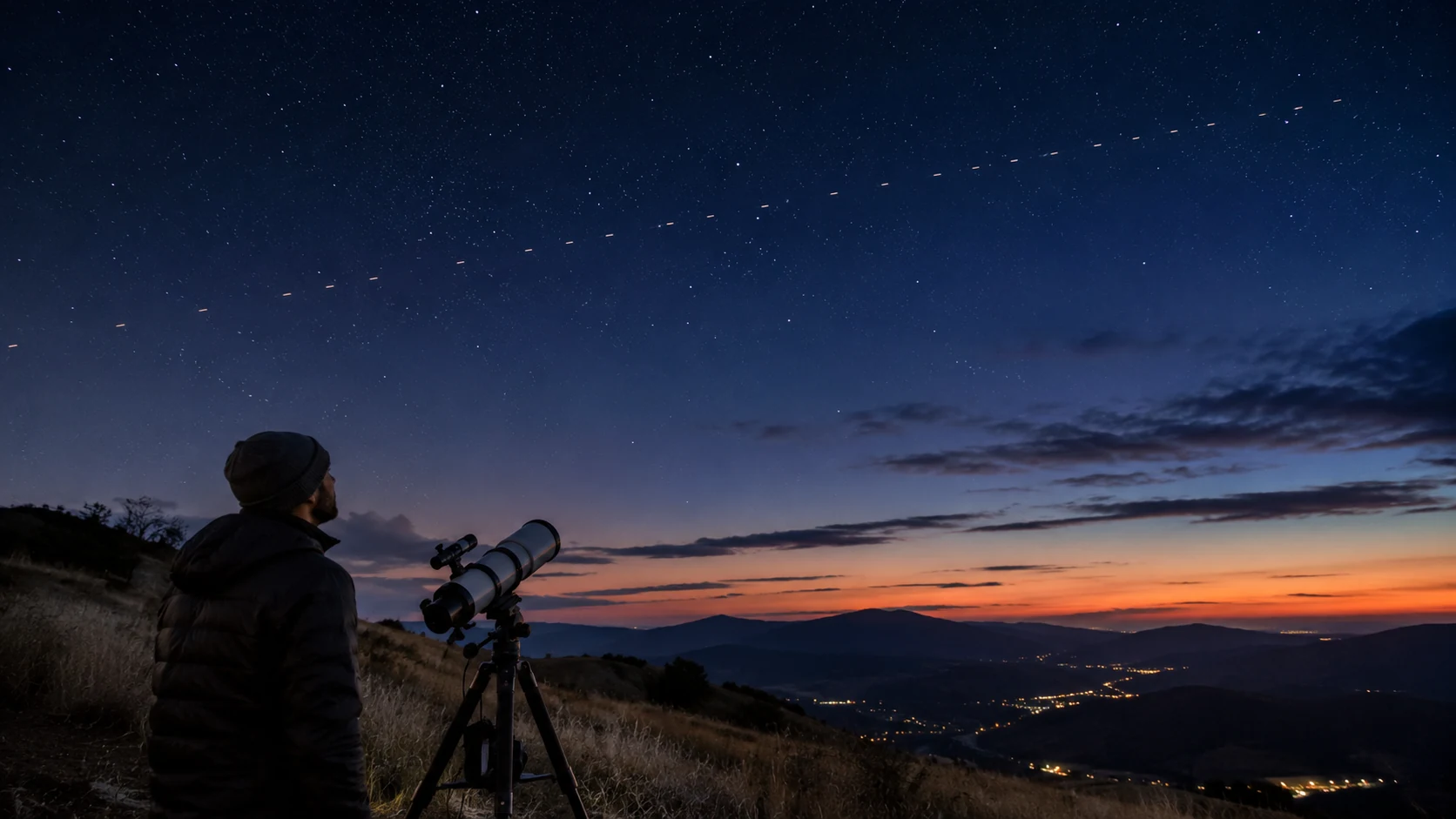
Several points follow roughly the same path and usually appear as steady lights. Brightness can change and objects may disappear in shadow. Newly launched satellites can be particularly conspicuous.
Aircraft and drones
Aircraft commonly show blinking navigation or strobe lights and may change direction in ways a satellite pass does not. Drones can hover or change course. At a distance, neither sound nor color alone is conclusive.
Meteors and reentries
A meteor generally produces a brief streak, often lasting only seconds. A reentering spacecraft or rocket body can break into multiple luminous fragments. A launch plume can form a large, expanding illuminated cloud. These are not the same as an ordinary line of orbiting satellites.
When the object remains unidentified
Unidentified simply means you have not established what the object was. Record details and compare satellite predictions, aircraft tracking and launch records. A visual impression alone cannot establish the object’s identity.
Reference guide · Updated November 24, 2026
Use a simple observation checklist
| What you saw | Likely category to investigate |
|---|---|
| Multiple evenly moving dots in a line | A recently deployed satellite train |
| One steady light crossing the sky | Satellite or aircraft; compare predictions |
| Repeating flashes or coloured lights | Aircraft or another local object |
| A short fast streak | Meteor or another transient event |
These are clues, not positive identifications. Clouds, perspective, camera artifacts and multiple objects can mislead. Do not infer an object's altitude, speed or origin from appearance alone.
Verify with time and location
A pass prediction requires an observer location and time, not merely the date. Record local time including time zone, compass direction, duration and approximate maximum elevation. Compare a current orbital prediction. A satellite fading at a common location in the sky may be entering Earth's shadow. Keep uncertain observations labelled as uncertain.
Evidence and further reading
- NASA: Spot the Station FAQ Government science
Explains reflected sunlight and visibility in Earth’s shadow; same illumination principle applies to other satellites.
Sources are linked to original publishers or identified public records. Plan documents and specifications may change. See the research library for evidence types and limitations.
Sources and live resources
Guide reviewed November 23, 2026. Live orbital data and service details change.
Explore related guides
- What is that line of moving lights in the sky?
- When can I see Starlink satellites tonight?
- How to watch a Starlink rocket launch and satellite deployment
Interested in using satellite internet?
Compare equipment and service costs or learn about referral eligibility before buying.
Planning tools · Dated pricing snapshot · Testing methods
Independent guide. I may receive a reward if you use my referral link and qualify. Not affiliated with Starlink or SpaceX.
Get Starlink $100 Offer ↗Eligible new US customers; two full qualifying billing cycles. Terms apply. Not a checkout discount. We may also receive a reward if you qualify. Offer details.