
Home / Space science & communications
Space science & communications center
Updated November 24, 2026 · Satellite Internet Insider editorial desk
Understand the numbers, explore the science and learn how space technology affects everyday life.
Learn • explore • connect
From the Sun to your satellite dish
What is it? What does the number mean? Why should I care? How does it affect my life? Every guide begins with these four questions.
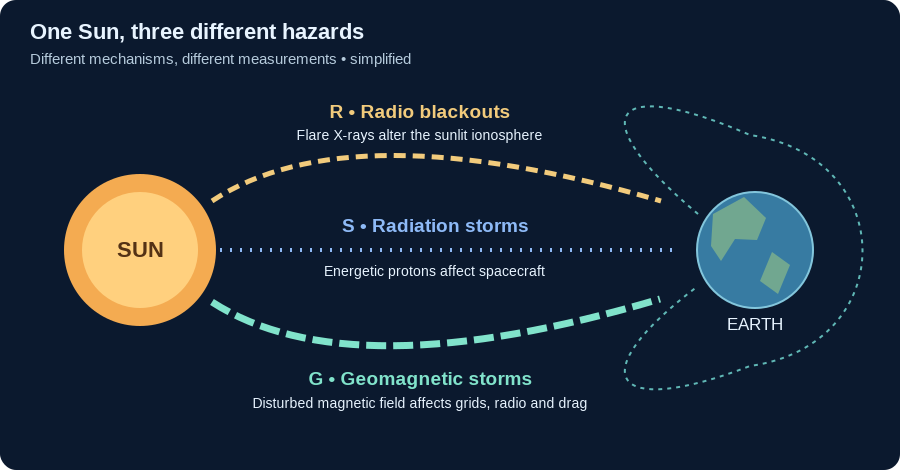
Space weather, EMP and everyday technology
What is the planetary Kp index?
Read the space weather dashboard without needing a background in physics.
Explore →What happens to Starlink during a solar storm?
Separate solar radiation, magnetic disturbances and ordinary service outages.
Explore →Can Starlink survive an EMP or a major solar storm?
Compare distinct electromagnetic hazards without assuming all electronics fail.
Explore →Would an EMP damage my phone or car?
Understand the uncertainty around household electronics, vehicles and communications.
Explore →What was the Carrington Event of 1859?
A historical case study of space weather and nineteenth-century communications.
Explore →What happened during the May 2024 solar storm?
The Gannon storm offers documented examples of modern space weather impacts.
Explore →How do solar storms affect GPS?
Understand navigation signal delays, position errors and the limits of Kp.
Explore →When can I see the northern lights?
Use space weather forecasts, darkness and location to plan a realistic observing session.
Explore →Does space weather affect amateur radio?
Learn why HF, VHF and UHF behave differently during solar activity.
Explore →Orbital science, the ISS and satellite communications
How does the ISS connect to the internet?
Follow data from an orbiting laboratory to Earth and learn why the ISS is not a Starlink relay.
Explore →Why does the ISS not collide with Starlink satellites?
Altitude alone cannot guarantee safety; timing and three-dimensional trajectories matter.
Explore →Can Starlink satellites collide with each other?
How orbital debris and collisions affect the safety of every satellite network.
Explore →Can I communicate with the ISS using ham radio?
A beginner-friendly guide to listening and lawful amateur radio contacts.
Explore →How do satellites communicate with one another?
Explore radio links, optical links, gateways and routing.
Explore →Why do satellites not fall to Earth?
Understand orbital free fall, gravity and speed.
Explore →Why does the ISS need to boost its altitude?
Even space stations encounter traces of atmosphere and need orbital maintenance.
Explore →Can satellites run out of fuel?
Why propulsion, station keeping and mission lifetime matter.
Explore →How are satellites protected from radiation?
Learn what radiation does to spacecraft electronics and why protection is mission-specific.
Explore →Learn by doing
Orbital Dodge
Play the fictional debris avoidance game, then learn about real conjunctions.
Explore →Constellation studio
Change altitude, inclination and satellite count.
Explore →Mission Control
Solve network routing challenges.
Explore →Survive the blackout
Practice managing energy and backup communication.
Explore →What’s in the sky tonight?
Explore planets, the Moon, sunrise, sunset and satellite passes.
Explore →Editorial principles · Research library · Corrections and questions