
Home / Starlink in the night sky
What is that line of moving lights in the sky?
Updated November 24, 2026 · 4 min read (approx.)
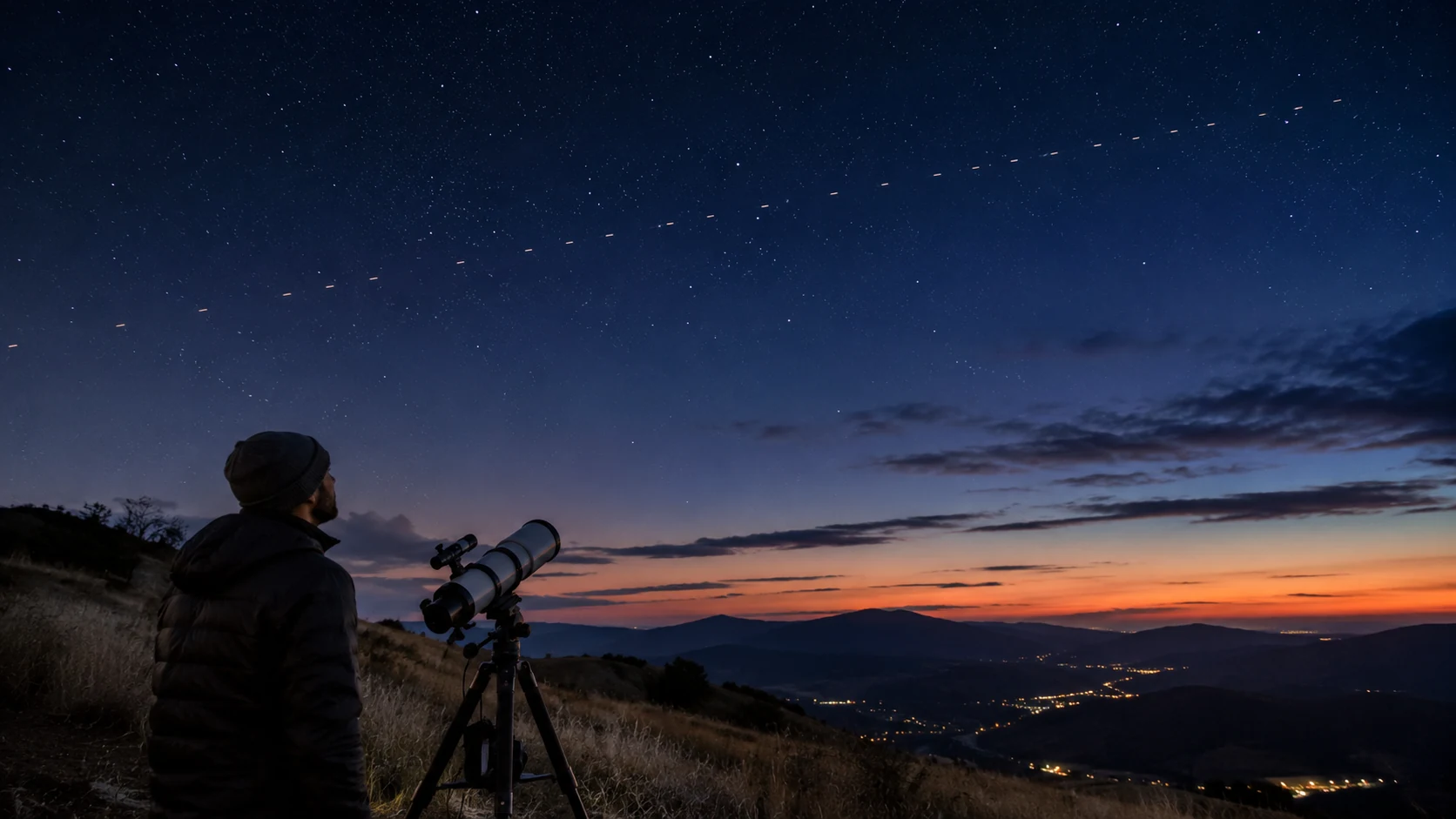
A chain of steady, star-like lights moving together is often a Starlink satellite train, especially in the days after a launch.
In this guide
- What you probably saw
- Why are they so bright?
- Why does the line spread out?
- What should you record?
- Why a train looks different from ordinary satellites
- What makes them visible?
- Document a sighting
- Evidence and further reading
- Related questions and next steps
- Sources and live resources
- Explore related guides
- Interested in using satellite internet?
What you probably saw
A rocket releases a batch of satellites into nearby orbits. From the ground, the objects may look like a string of pearls crossing the sky. They follow similar paths, not a physical cable or formation held together by a structure. A sighting cannot be confirmed from appearance alone.
Why are they so bright?
The visible light is reflected sunlight, not a row of headlights. Around twilight, the ground may be dark while spacecraft high overhead are still illuminated. A satellite can disappear abruptly when it enters Earth’s shadow.
Why does the line spread out?
After deployment, the spacecraft adjust their orbits and gradually separate. The distinctive train generally becomes less obvious as they disperse and change orientation. Individual operational satellites can still be visible.
What should you record?
Write down the local date and time, nearest town, direction of movement, approximate height above the horizon and whether the lights flashed. Use the viewing guide to compare the observation with predicted passes. A photograph with a timestamp helps.
Reference guide · Updated November 24, 2026
Why a train looks different from ordinary satellites
Many spacecraft from the same launch can initially have similar trajectories and spacing. From the ground they appear as a sequence of moving points. As the spacecraft adjust their orbits and spread out, the compact train becomes less obvious. A mature satellite may appear as a single moving point rather than part of a line.
What makes them visible?
Typically the points are reflecting sunlight. The observer may be in darkness while the spacecraft are still illuminated at orbital altitude. When they enter Earth's shadow or change viewing geometry, the dots can fade without the satellites stopping. Brightness varies and a prediction is not a guarantee of visibility.
Document a sighting
Note date, time zone, approximate location, compass direction and whether the lights flashed or moved steadily. Compare with a satellite prediction service and aircraft information if available. For photographs, use a stable camera and record the timestamp. A streak in a long exposure does not establish that the object itself is moving unusually fast.
Evidence and further reading
- NASA: Spot the Station FAQ Government science
Explains reflected sunlight and visibility in Earth’s shadow; same illumination principle applies to other satellites.
Sources are linked to original publishers or identified public records. Plan documents and specifications may change. See the research library for evidence types and limitations.
Sources and live resources
Guide reviewed November 23, 2026. Live orbital data and service details change.
Explore related guides
- When can I see Starlink satellites tonight?
- Starlink, airplanes, meteors or UFOs: how to identify lights in the sky
- How high and how fast are Starlink satellites?
Interested in using satellite internet?
Compare equipment and service costs or learn about referral eligibility before buying.
Planning tools · Dated pricing snapshot · Testing methods
Independent guide. I may receive a reward if you use my referral link and qualify. Not affiliated with Starlink or SpaceX.
Get Starlink $100 Offer ↗Eligible new US customers; two full qualifying billing cycles. Terms apply. Not a checkout discount. We may also receive a reward if you qualify. Offer details.
Explore the sky interactively
Why are satellite trains sometimes harder to see now?
Satellite designers have tried changing surface reflectivity and spacecraft orientation to reduce the amount of sunlight reaching observers. The result varies with model, viewing geometry and orbital phase. New launches can still be bright while satellites are close together and raising their orbits.
A 2026 Monthly Notices of the Royal Astronomical Society photometry study analyzed observations from 2021–2023 and normalized them to a common 550 km altitude. Its median visible-band magnitudes were 5.37 for original v1.0 satellites, 6.01 for Gen-2, 6.11 for v1.5, and 6.62 for VisorSat. Larger magnitudes mean fainter objects. Gen-2 had only six measurements in that sample; these historical medians are not tonight’s brightness forecasts. The research found progress but did not establish that all modern satellites meet astronomy mitigation targets.
Read the independent 2026 photometric study. Use fresh pass predictions and dark skies; no sighting is guaranteed.