
Home / Space & astronomy
What’s in the sky tonight?
Choose a location and date to discover sunrise, sunset, Moon phases, planets, meteor showers, eclipses and possible ISS viewing opportunities. No orbital data entry required.
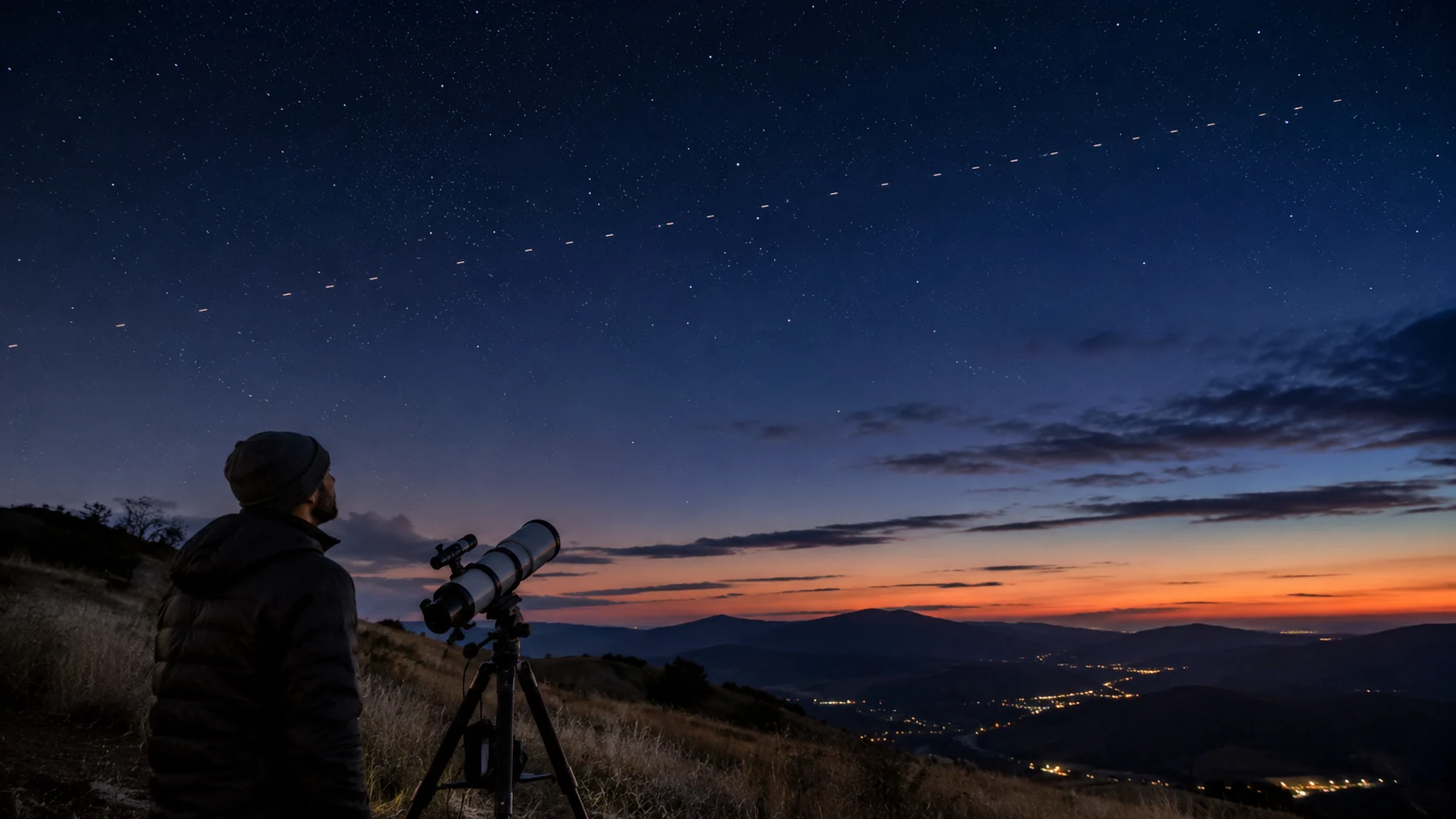
Pick a point on the map or use your current location. We calculate your local sky in your browser. You can also look up the ISS, recent satellite trains and other objects.
Live ISS and space weather · Play the sky identification game
Plan tonight’s observing session
Start with a location and date. You do not need to understand or enter satellite orbital elements. The sky forecast works even when satellite feeds are unavailable.
Your sky forecast
Sunrise, sunset & twilight
The Moon tonight
Planets worth looking for
Highest sampled altitude during the selected night with the Sun at least 6° below the horizon. Visibility also depends on glare, brightness and weather. Never point optical instruments toward the Sun.
Explore your sky
Move the time slider to see approximate positions of prominent stars, planets and the Moon. North is at the top, the rim is the horizon and the center is directly overhead.
Meteor showers
Approximate recurring seasonal windows, not current outburst or rate forecasts. Peak dates vary by year.
Upcoming eclipses
Dated NASA calendar through 2027. Local lunar horizon checks use your selected coordinates; solar visibility requires a path map.
Comets & unusual objects
Comet positions and brightness can change rapidly. We do not estimate a live comet forecast from old observations.
On Nov 23, 2026, COBS observations reported comet 161P/Hartley-IRAS near magnitude 11.4 and C/2026 A2 (Bok) near magnitude 12.6. These are dated telescopic targets, not a naked-eye forecast.
Check current comet charts for this location ↗
This optional external link includes your rounded coordinates. JPL Horizons ephemerides.
More satellite passes
We automatically calculate ISS candidates when fresh data is available. To see additional satellite predictions and recently launched trains, use these observing services.
More satellites for this location ↗ · Find Starlink trains
The first external link includes your rounded coordinates. Satellite trains can be faint or absent even if a geometric pass is predicted.
Methods: Paul Schlyter’s low-order planetary position formulas; selected bright-star catalog coordinates (approximate J2000); standard sidereal and horizon transformations; IMO; NASA eclipse catalog. The Moon’s parallax is approximated; the model is suitable for planning casual observation, not precision telescope pointing. Local sky calculations are supported for 2000–2050.
ISS & custom satellite viewing opportunities
Fresh satellite data is loaded separately from your local sky forecast.
Select a location and date. Local astronomy does not require a satellite data feed.
Satellite candidate passes use SGP4 via satellite.js, 20-second sampling, minimum elevation 15°, Sun below −6° for the observer and an approximate Earth-shadow filter. Fresh ISS orbital data is fetched automatically; optional TLEs allow selected custom objects. Dates more than seven days from the orbital epoch are rejected. Times are shown in the selected time zone. Visibility also depends on brightness, cloud, maneuvers and element age.
Orbital data formats · Data usage policy · NASA viewing guidance
What did I see?
A moving line of lights
Recently deployed satellite trains and how they spread out.
Explore →A point suddenly vanished
Sunlight, Earth’s shadow and the viewing geometry.
Explore →A blinking light or streak
Compare planes, meteors, satellites and other objects.
Explore →Try the sky identification game
Six illustrative scenarios to sharpen your observation skills.
Explore →Keep exploring
Updated November 24, 2026 · Editorial policy
Why are satellite trains sometimes harder to see now?
Satellite designers have tried changing surface reflectivity and spacecraft orientation to reduce the amount of sunlight reaching observers. The result varies with model, viewing geometry and orbital phase. New launches can still be bright while satellites are close together and raising their orbits.
A 2026 Monthly Notices of the Royal Astronomical Society photometry study analyzed observations from 2021–2023 and normalized them to a common 550 km altitude. Its median visible-band magnitudes were 5.37 for original v1.0 satellites, 6.01 for Gen-2, 6.11 for v1.5, and 6.62 for VisorSat. Larger magnitudes mean fainter objects. Gen-2 had only six measurements in that sample; these historical medians are not tonight’s brightness forecasts. The research found progress but did not establish that all modern satellites meet astronomy mitigation targets.
Read the independent 2026 photometric study. Use fresh pass predictions and dark skies; no sighting is guaranteed.
New · Space science & communications