

1. Compare services before comparing companies
The term satellite internet covers several markets. Household broadband is different from aviation or maritime connectivity, industrial data links, low-power asset trackers and emergency messengers. Providers may operate multiple networks, partner with resellers, or sell products only through enterprise contracts. The most useful comparison is by the job you need done and the equipment that serves it, not total satellites or a marketing speed claim.
| Operator / brand | Network category | Typical reason to investigate |
|---|---|---|
| SpaceX / Starlink | LEO broadband | Home, portable and managed connectivity |
| Amazon Leo | LEO broadband deployment | Emerging broadband alternative; verify launch/service status |
| Eutelsat OneWeb | LEO managed broadband | Enterprise, telecom, aviation, maritime |
| Hughesnet | Primarily GEO residential broadband | Address-based fixed home service |
| Viasat | GEO and broader satellite services | Fixed home, business, aviation/maritime portfolio |
| Iridium | LEO mobile satellite | Voice, messaging, specialized and industrial data |
| Globalstar | LEO mobile/IoT and related services | Tracking, messaging, device partnerships |
2. SpaceX and Starlink
Starlink uses low-orbit spacecraft and electronically steered customer terminals. It has consumer and mobility products as well as business-oriented service. A key advantage is availability in places without strong terrestrial networks; a key constraint is the terminal's need for workable sky access, service capacity and power. The Mini is aimed at portable situations; Standard and other equipment families address different workloads. Plan terms, hardware costs, priority and mobility rules change, so consult a local quote. The complete Starlink guide provides a purchase checklist.
Compare Starlink with an available local fiber or cable plan before replacing an existing reliable connection. The fact that satellite offers rural reach does not guarantee it is the least expensive choice for an urban customer. For backup, compare the cost of a separate path with the likely cost of outages.
3. Amazon Leo, formerly Project Kuiper
Amazon describes a LEO broadband network with optical inter-satellite links, terrestrial gateways and several terminal sizes. Full-scale deployment began in April 2025 according to the company. Network architecture, planned terminal capabilities and satellite deployment are different milestones from commercial service at an individual address. An announced rollout or test does not establish retail pricing, coverage or reliable customer performance.
Compare a future quote on equal terms: hardware, monthly cost, latency, real upload speed, data policy, mobility, installation, contractual obligations and service availability. Our Amazon Leo guide and news center distinguish development announcements from actual service. Amazon's proposed direct-to-device system is another separate capability; do not confuse a future filing with an already available phone plan.
4. Eutelsat OneWeb
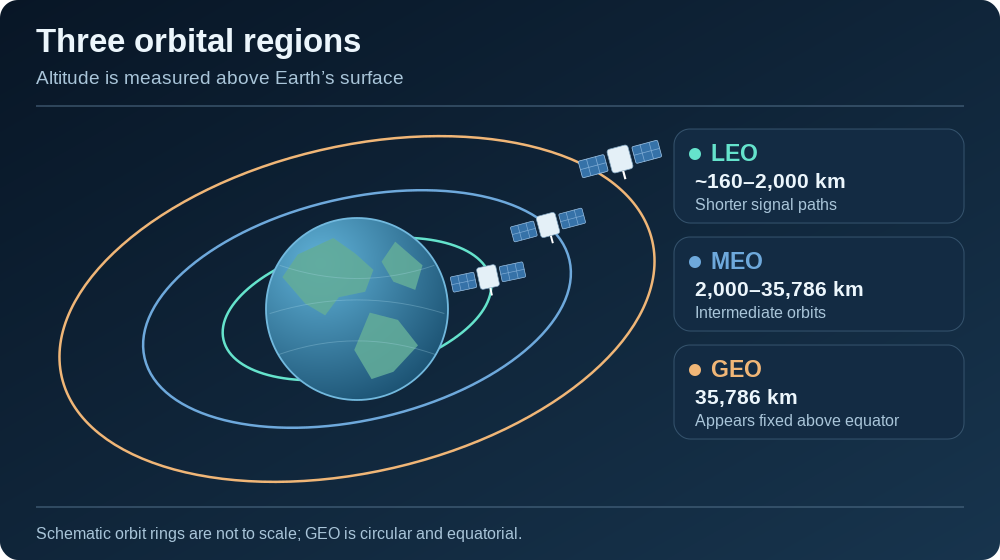
OneWeb operates a LEO constellation at approximately 1,200 km, according to Eutelsat. Its business model emphasizes connectivity for organizations, telecom providers and specialized mobility markets through managed solutions. This can be useful for a business needing a network architecture, security requirements or a service commitment rather than a simple retail subscription. The operator also has GEO capabilities through Eutelsat's broader portfolio.
Its customer hardware, channel, contracts and performance targets may differ significantly from Starlink's consumer offerings. For a remote industrial site, ask about coverage, service level terms, installation, spare hardware, support and escalation. The operator announced in October 2026 that its first batch of renewal satellites was ready for launch preparations; this is a dated announcement, not a confirmation of later launch success.
5. Hughesnet and Viasat
Traditional geostationary broadband uses satellites that appear fixed relative to the ground. A fixed antenna can be aligned to an available spacecraft, with no LEO-style moving-satellite handoff for ordinary fixed access. Long propagation distance contributes substantial latency; high throughput does not eliminate that physical delay. Buffered streaming and browsing may be more tolerant than interactive applications, depending on service and network management.
Hughesnet and Viasat have address-specific offers, contract conditions and equipment arrangements. Obtain current written quotes, compare data or priority policies and check fees after a promotion. Viasat's residential website discusses ViaSat-3 capacity and varies offers by location. Some plans or products may combine multiple technologies, so verify the exact service rather than assuming every offer has identical performance. We do not quote a current Hughesnet price because its site restricted direct retrieval during this review; use its official address lookup.
6. Iridium and Globalstar
Iridium uses a LEO network with crosslinked satellites and L-band user communications. The operator describes coverage that includes high-latitude regions and a constellation operating around 780 km. Its range of voice, messaging and specialized data products addresses different needs from a household broadband terminal. A compact voice or messaging device may be more practical than a dish for certain wilderness or maritime uses. Service availability and regulatory permissions still matter.
Globalstar provides satellite communication services including asset tracking and personal safety applications. The best device for a user may be sold through a partner rather than under the network operator's own brand. Check the device's two-way capabilities, coverage, service subscription and emergency routing. In April 2026 Amazon and Globalstar announced an acquisition agreement; an agreement is not proof that all regulatory conditions have been satisfied or that the transaction has closed. Do not infer product availability from merger plans.
7. Match the provider to your workload
| Workload | Questions that matter more than a speed headline |
|---|---|
| Rural family | Total annual cost, evening performance, install constraints |
| Remote employee | Upload, packet loss, VPN compatibility, failover |
| RV traveler | Country and in-motion permissions, data and power |
| Industrial site | Network separation, support, spare kit, SLA |
| Wilderness hiker | Weight, battery, two-way messaging, distress routing |
| Ocean vessel | Approved equipment, maritime coverage and distress requirements |
A life-safety beacon is not a broadband product. A business-managed connection is not interchangeable with residential retail service, even if both use LEO. A competitor's advertised maximum speed may be a network capability rather than a guaranteed per-user speed. Ask for the product's actual conditions and service availability.
8. A neutral comparison method
Create a scorecard for each offer using the same address and time horizon. Record quote date, country, hardware, activation, installation, twelve months of service, data policies, taxes and cancellation costs. Include latency, upload and reliability requirements. Ask whether support is direct or through a reseller. Record unknowns as unknown, not zero or estimated facts. The provider directory gives official entry points and the global directory provides regional research links.
9. Future competition and sustainability
Satellite companies must fund spacecraft replacements, launches, terminals, gateway capacity and spectrum coordination. New constellations may bring competition and coverage options; their plans, launch schedules and filings do not guarantee commercial success. More spacecraft also increase demands on orbital traffic management and astronomy mitigation. Compare deployment milestones using the industry timeline, and read ESA's latest report for broader orbital context. Recheck sources before relying on a forecast or promotional offer.
10. Worked scorecard: selecting a service for a remote office
Imagine a small office at a remote location that needs to upload files and maintain occasional video calls. The owner obtains quotes from a local fixed provider, a consumer LEO service and a managed satellite reseller. The quotes are not directly comparable: the managed service may include installation and escalation support, while the consumer option may offer simpler hardware purchase and no equivalent service commitment. Record the actual upload requirement, hours of operation, consequences of failure, and how quickly technical support can respond. Ask what happens during network congestion or equipment failure. A lower monthly price is attractive only if the service can meet the workload.
For critical operations, compare redundancy designs too. A wired or cellular link plus satellite may provide a better solution than two terminals attached to the same satellite operator. A managed router and separate power supply can reduce downtime, but only if the configuration is tested. Request documentation for public addressing, VPN compatibility, remote management and authorized use before signing a contract.
11. Compare advertised coverage and actual service
A global map can represent the underlying network footprint rather than a retail product available to a particular customer. A maritime plan may be sold by a partner with separate equipment, while a residential plan may require an eligible land address. A mobile messaging device can have a different coverage map from another device using the same underlying operator. Regulatory restrictions also differ by country. Ask the official provider or reseller about the exact terminal and service at the intended location, rather than assuming any product bearing a network logo can connect everywhere.
12. What belongs in an independent provider comparison
A credible review separates the operator's published specifications from measured field results. It identifies the date, market, service plan, test methodology and limitations. It does not award a speed or price winner based on a maximum advertised figure from one company and a real-world measurement from another. When a provider has not yet published a retail price, the correct entry is unknown, not an estimated price presented as fact. When a satellite has been manufactured but not deployed, it is a manufacturing milestone, not an operating satellite. Our historical archive and timeline follow this approach.