
Best satellite internet: compare real performance
Updated November 24, 2026 · 3 min read (approx.)
An evidence-led guide to choosing satellite broadband, with measured US speeds, latency, alternatives and buying considerations.

Quick answer
If you need US residential satellite broadband today, Starlink is a strong first option for most households with an unobstructed installation and a suitable plan. Its measured speed and latency advantage is substantial. It is not automatically the cheapest option, the best internet overall, or the right choice for every location.
In this guide
Download
Higher is better
Upload
Higher is better
Latency
Lower is better
Q1 2026 US national medians, not guaranteed performance. Source: Ookla, May 5, 2026 (accessible copy). Download, upload and latency are distinct measurements.
What the differences mean
In this dataset, Starlink delivered around 2.6 times the median download rate of Hughesnet and 3.1 times that of Viasat. Lower delay matters for conversation, gaming and remote desktops; uploads matter for calls, file sharing and backups. Faster downloads help large files and streaming, but a high download rate alone cannot eliminate lag.
Why low Earth orbit helps
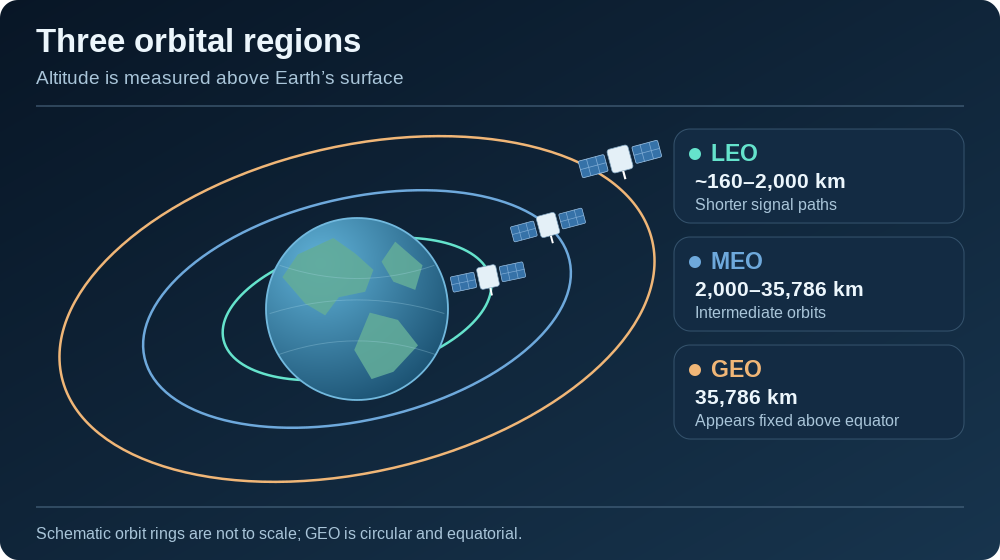
Geostationary satellites orbit about 35,786 km above Earth. Low-orbit systems can shorten the radio path dramatically, although real latency also depends on gateway routing, scheduling, congestion and the local network. Hughesnet Fusion uses a terrestrial component where available, so do not generalize a GEO-wide median to every hybrid subscriber.
Compare before committing
Consider Starlink first
For rural homes without good wired broadband, travel with approved equipment and plans, or low-latency satellite backup. Scan the sky and verify the exact address and total cost.
Complete Starlink guideConsider alternatives
Fiber or cable can deliver better consistency or uploads. A strong cellular connection may be easier to power and cheaper. Compare Hughesnet or Viasat where Starlink cannot be installed or another provider has a better total quote.
Compare all internet technologiesWatch emerging networks
Amazon Leo is conducting enterprise previews. As of November 24, 2026, general residential ordering and published consumer prices were not verified. Do not compare announced maximum antenna speeds with measured household medians.
Official Amazon Leo site · Leo explainedHow to evaluate your own service
- Check address-specific availability and the FCC National Broadband Map.
- Compare hardware, installation, regular subscription prices, data policies, contract and cancellation terms in the same currency. Use our provider directory.
- Scan the proposed site with the manufacturer's app and account for independent power if this is a backup.
- After installation, measure performance across several times of day, including uploads, latency and interruptions. National medians are not a substitute for local testing.
Sources and limitations
- Ookla: Starlink Hits New Highs in the U.S. — Q1 2026 data, May 5, 2026. Speedtest samples are self-selected and influenced by plans, locations, devices and test conditions.
- Benton Institute: 2025 Global Satellite Broadband Performance Report — global context from Ookla.
- Starlink installation requirements — manufacturer guidance, not independent testing.
- Amazon's enterprise preview announcement — November 24, 2025.
Already decided on Starlink?
Check available plans and potential US referral reward. New eligible customers must complete two full qualifying high-speed billing cycles; conditions apply. This is not a checkout discount.
Referral disclosure: the publisher may also receive a reward if you qualify. Details.
Get Starlink $100 Offer ↗Eligible new US customers; two full qualifying billing cycles. Terms apply. Not a checkout discount. We may also receive a reward if you qualify. Offer details.
Official terms