
Does Starlink work in wooded areas?
Updated November 23, 2026 · 4 min read (approx.)
Trees and dense foliage can block the satellite path. A small gap in the canopy may not be enough for continuous service.
In this guide
- Scout the site
- Match the use case
- Find alternatives
- Distinguish the edge of a forest from overhead canopy
- Survey your property in a repeatable way
- What the independent study does and does not establish
- Evidence and further reading
- Related questions and next steps
- Sources and further reading
- The physics of foliage and adaptive satellite selection
- Keep exploring
- Partial sky may be enough
- New practical resources
Scout the site
Use the provider's obstruction scanner from the exact planned dish position, not just the driveway. Consider seasonal foliage, nearby ridges and buildings. A clearing may work better than a spot directly beside the cabin.
Match the use case
An intermittent connection might be acceptable for downloading messages but disruptive to calls and VPN sessions. Review obstruction and outage statistics over a representative period.
Find alternatives
Consider a safely installed mount with an appropriate sky view, or a wired link from a more open part of the property. Never climb trees or roofs without proper equipment and expertise. Compare cellular service if the property cannot provide clear sky.
Reference guide · Updated November 24, 2026
Distinguish the edge of a forest from overhead canopy
Trees to one side may leave other satellite paths available. A dense roof of foliage can block many paths at once; the same property may perform differently between leaf-off winter and full summer foliage. Wet vegetation and moving branches can also change reception. Do not use tree count or acreage as a substitute for the actual angular sky view.
Survey your property in a repeatable way
Mark candidate safe locations, scan each with the app from the intended height, and compare the expected use. Test a ground-level clearing before considering a tall mount. After setup, examine the terminal's actual obstruction map and interruption log over multiple days. Make a note of foliage state and weather.
What the independent study does and does not establish
The controlled 2026 study provides evidence of adaptive satellite selection under introduced blockages. It is not a field survey of every tree species or terrain type. Do not translate its average changes into a guaranteed percentage of service availability for a forested property. If you require uninterrupted video or work connectivity, measure your own acceptance criteria and retain a fallback.
Evidence and further reading
- Kataria et al., What Obstructed Skies Teach Us About Satellite Internet (2026) Independent research
Controlled obstructions and evidence of satellite selection adapting to blockages; not a universal outage forecast.
- Starlink: Prepare for install and select a location Manufacturer guidance
Sky visibility, mounting and siting guidance.
- Starlink: Checking obstructions Manufacturer guidance
Pre-install scanning and observed obstruction maps are different measurements.
- Starlink app alerts Manufacturer guidance
Distinguishes Wi-Fi, obstruction, overheating and service outages.
Sources are linked to original publishers or identified public records. Plan documents and specifications may change. See the research library for evidence types and limitations.
Sources and further reading
The physics of foliage and adaptive satellite selection
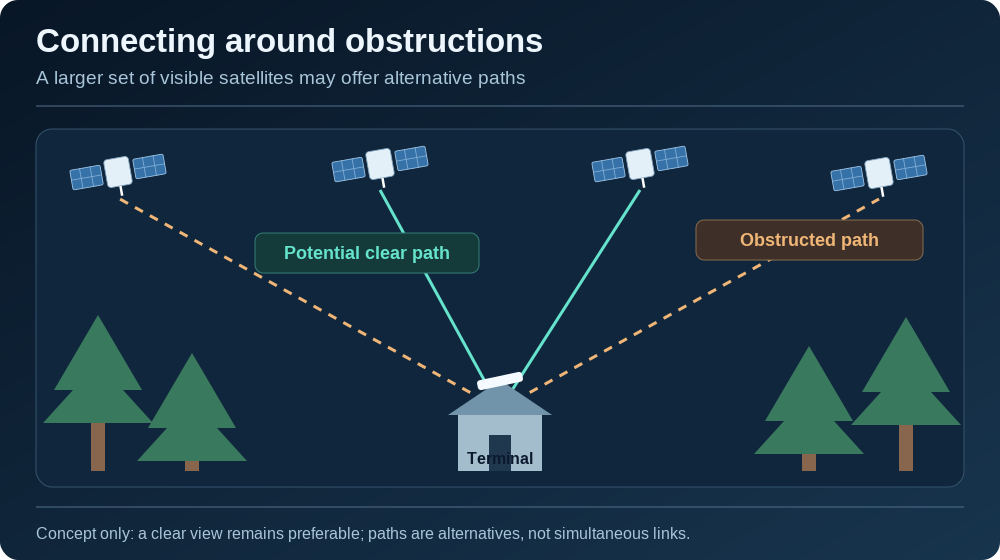
Vegetation can weaken radio signals; the effect depends on frequency, vegetation depth and conditions. The ITU publishes engineering guidance on this phenomenon. More available satellites may give the terminal alternative paths, but they cannot remove a continuous overhead obstruction.
A 2026 controlled study observed switching around blockers, while also finding residual degradation. Test in summer leaf-on conditions and after rainfall if possible. For a video-call connection, check packet loss and the frequency of interruptions, not only Mbps.
Read our full obstruction science guide.
Sources and further reading
Keep exploring
- Starlink installation: where to put your dish
- Starlink for rural homes, farms and cabins
- Can Starlink work through a window?
Partial sky may be enough
Starlink now describes partial sky visibility as often sufficient, with satellite switching sometimes avoiding trees and buildings. Clear sky remains preferable, especially for live calls. Official installation guidance.
New practical resources
Improved partial-obstruction performance · Check your installation conditions · Before-you-buy checklist
Compare current Starlink offers
Independent guide. We may earn a referral reward if you order through this link and qualify. Eligibility, prices and terms vary.
Get Starlink $100 Offer ↗Eligible new US customers; two full qualifying billing cycles. Terms apply. Not a checkout discount. We may also receive a reward if you qualify. Offer details.
Read the conditions