
What happens to Starlink during a solar storm?
Updated November 24, 2026 · Satellite Internet Insider editorial desk
Space weather can affect satellites, radio signals, navigation and ground infrastructure. The severity and type of event determine the risk.
Beginner’s explanation · November 24, 2026
In this guide
What is it?
A solar flare is a rapid release of radiation. A coronal mass ejection (CME) is an eruption of plasma and magnetic field. A solar energetic particle event can expose spacecraft to high-energy particles. These events can occur together but are not interchangeable. A CME directed toward Earth can disturb the magnetosphere if its magnetic configuration couples effectively to Earth’s field.
What do the numbers mean?
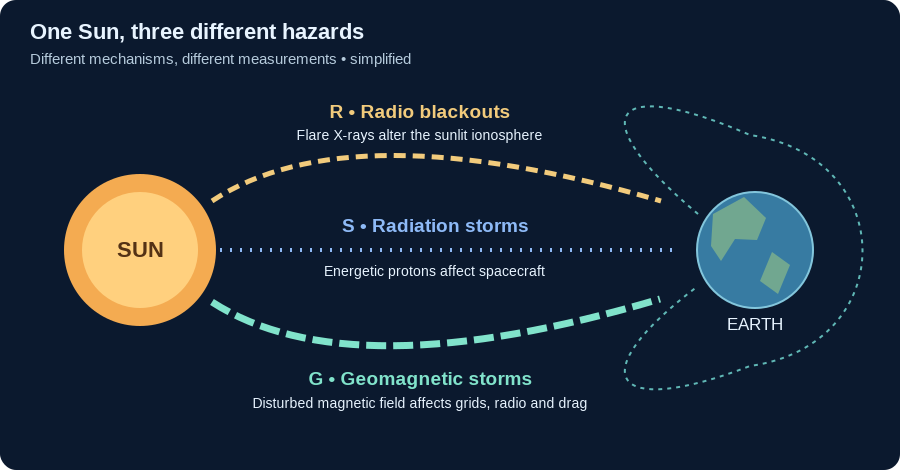
NOAA uses G for geomagnetic storms, S for radiation storms and R for radio blackouts. A G level is related to Kp; R depends on solar X-ray intensity and S on energetic proton flux. A high R reading can occur without a high Kp reading. No single scale measures all space weather risk.
Why should I care?
In low Earth orbit, a heated upper atmosphere expands and increases drag. Satellites may need additional tracking and orbit maintenance. Disturbed ionospheric conditions can affect navigation and radio links; radiation may cause spacecraft electronics faults. A broadband network also relies on ground gateways, terrestrial routing and electricity. The terminal is only one link in that chain.
How does it affect my life?
During the May 2024 Gannon storm, NASA’s event record describes degraded Starlink service alongside GPS and HF radio difficulties. This is evidence that disruption is possible, not that every severe storm disables every dish. If your service fails, check local power, obstructions, provider status and NOAA alerts before attributing it to the Sun. Keep independent communications and charged backup power for important needs.
A useful observation
Record a service interruption with its local time, duration, dish obstruction log, power state and provider status. Compare it with dated NOAA observations afterward. Correlation is not proof of causation: rain, local congestion and cable faults can occur at the same time.
Sources and further reading
Public science, agency guidance and official documentation
Explanations are editorial summaries. Calculations and examples are illustrative unless identified as observations. Editorial standards · Suggest a correction.
In this guide
What changes in orbit
Geomagnetic disturbances can heat the upper atmosphere, increasing drag on low-orbit satellites. Operators may need to adjust their orbits. Energetic particles and changes in the ionosphere can also affect electronics and radio propagation.
What users may notice
An event does not guarantee a service outage at your address. Changes can be local or widespread, and power-grid disruptions may affect your setup even if the satellite network is functioning. NOAA publishes space-weather alerts.
Prepare sensibly
Keep independent communication paths and a charged power source, and download essential information. Do not rely on unverified predictions of a total internet collapse. Check official provider notices and NOAA's forecasts.
Reference guide · Updated November 24, 2026
Three distinct space-weather mechanisms
Solar flares can disturb radio propagation; energetic particles can affect spacecraft electronics; geomagnetic storms can heat the upper atmosphere and increase drag on low-orbit spacecraft, while also affecting ground infrastructure. NOAA explains these mechanisms separately. The magnitude, timing and effects vary from event to event.
Why low orbit matters
Low-orbit satellites encounter a tenuous atmosphere. If that atmosphere expands during heightened space weather, drag can increase. Operators may need to adjust orbit management, especially for spacecraft at low deployment altitudes. This is different from a consumer dish's local reception in rain.
What a household can do
Follow official space-weather and provider notices, keep independent power charged and maintain offline emergency information. Do not infer a solar storm from a single slow test. No public evidence guarantees that every satellite and ground system will survive an extreme event unchanged. The useful response is communications redundancy, not an unsupported promise of immunity.
Evidence and further reading
- NOAA Space Weather Prediction Center: Space Weather Impacts Government science
Solar radiation, radio propagation, geomagnetic disturbances and infrastructure impacts.
- Ready.gov: Make a plan Government preparedness
Family contacts, meeting places and emergency planning.
Sources are linked to original publishers or identified public records. Plan documents and specifications may change. See the research library for evidence types and limitations.
Sources and further reading
Keep exploring
- What happens to retired Starlink satellites and the night sky?
- Would Starlink work during a nationwide internet outage?
- Does Starlink work in rain, snow and storms?
Compare current Starlink offers
Independent guide. We may earn a referral reward if you order through this link and qualify. Eligibility, prices and terms vary.
Get Starlink $100 Offer ↗Eligible new US customers; two full qualifying billing cycles. Terms apply. Not a checkout discount. We may also receive a reward if you qualify. Offer details.
Read the conditions