
From science fiction to practical networks
In 1945 Arthur C. Clarke described communications relays in high equatorial orbits. Sputnik in 1957 demonstrated artificial satellites, not internet service. Its radio transmissions were simple signals. That distinction matters: the history of satellite communications is a progression from proving radio reception from space to building networks that move large amounts of information between users.
| Year | Event | Why it mattered |
|---|---|---|
| 1957 | Sputnik 1 | First artificial satellite |
| 1960 | Echo 1 | Passive reflection experiments |
| 1962 | Telstar and Relay | Active transatlantic communication experiments |
| 1963 | Syncom missions | Tested near-synchronous communications |
| 1964 | Syncom 3 | Geostationary relay |
| 1965 | Early Bird (Intelsat I) | Commercial international communications |
| 1998 | Iridium operational | Global mobile satellite network |
| 2019 | First 60-satellite Starlink launch in May | Large LEO broadband deployment era |
| 2025 | Amazon Leo full-scale deployment begins | Emerging LEO competition |
NASA and ITU's histories explain early developments; Iridium and Amazon's dates are their own published accounts. See the dated industry timeline for later developments.
Why GEO dominated communications for decades
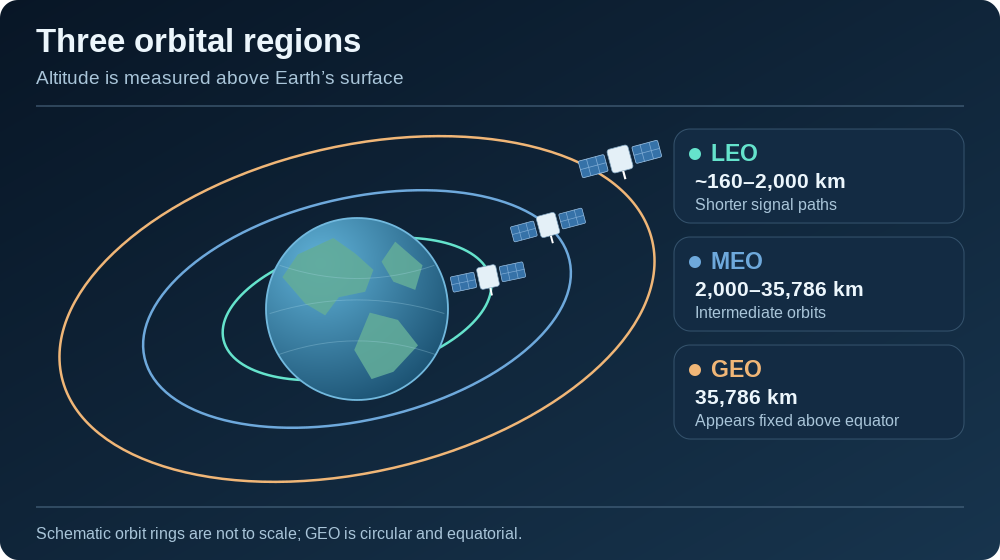
A geostationary spacecraft appears fixed in the sky. Ground dishes can be installed with a stable orientation, reducing the tracking complexity. A small number of spacecraft can cover broad regions, useful for television, telephone trunks and remote fixed links. The disadvantages include long round-trip propagation time and finite regional capacity. Larger satellites and spot beams increased capacity without eliminating the physical distance.
Why LEO became attractive again
Lower orbits shorten the signal path but require many spacecraft, active tracking and frequent handoffs. Improvements in computing, radio electronics, electronically steerable antennas, mass production and launch economics made modern LEO broadband more feasible. The history is not a simple replacement of GEO by LEO: each architecture still has useful applications, and some operators combine orbital regimes.
From broadcast to interactive internet
Television distributes the same stream to many households. Internet service must support individual requests, uploads, congestion control, security and routing. Broadband spacecraft therefore serve an entirely different traffic pattern. A provider must operate a network of terminals, spacecraft, ground stations and Internet interconnections, and replace hardware across its lifecycle. The economics and environmental challenges are inseparable from the engineering.