
Does Starlink work in mountains and valleys?
Updated November 23, 2026 · 4 min read (approx.)
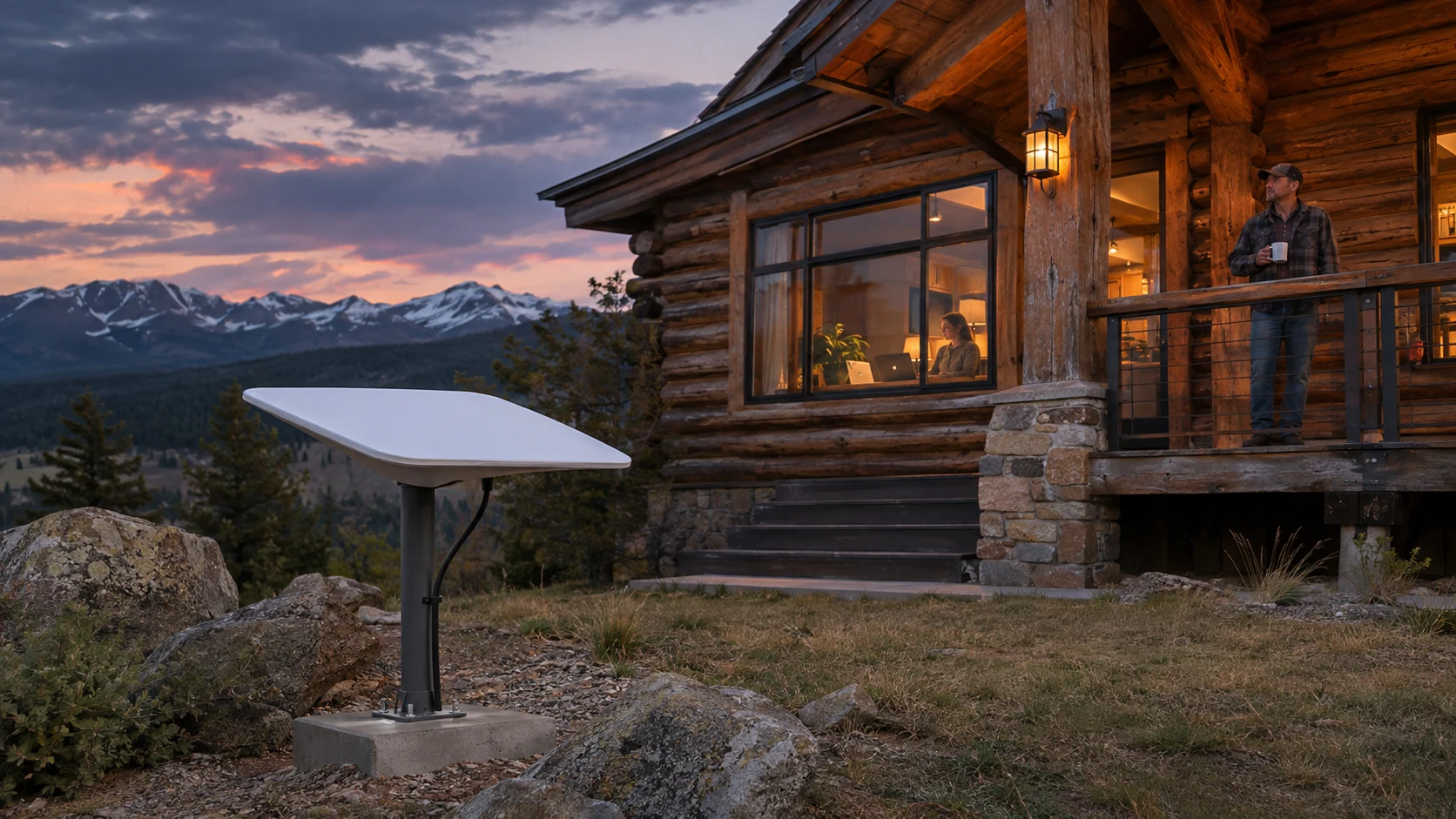
Mountain ridges can mask large portions of the sky even if the immediate property has no trees.
In this guide
Scout several locations
Compare sky scans at a clearing, driveway and proposed mounting point. A higher location is not automatically better if another ridge blocks the view.
Plan winter operation
Keep equipment accessible without climbing icy roofs. Check snow accumulation, power availability and cable routing.
Evaluate reliability
Measure interruptions as well as throughput; keep an independent communications option for remote emergencies.
Useful next steps
Installation suitability checker · Cost calculator · Wooded properties · Buying checklist
Reference guide · Updated November 24, 2026
How terrain changes the visible sky
A mountain ridge can block a broad angular sector. A valley that is wide north-to-south may expose a different set of satellite paths from a narrow canyon. A satellite does not need to be directly overhead, but it must have an usable line of sight within the system's permitted geometry. Elevating a dish a few feet may clear nearby shrubs without removing a distant ridge.
Choose candidate locations
Scan the open part of your property first, then a safely accessible raised location if necessary. Compare the same hardware and height assumptions. Use a topographic map to identify terrain context, but do not treat it as a precise radio model. Seasonal snow, foliage and weather should be included in your test notes.
Plan for critical communications
A cabin without reliable roads or cell coverage may need an independent satellite messenger or other appropriate emergency option as well as broadband. Maintain stored power and offline contacts. If the only possible mount requires risky work on a cliff or roof, choose professional installation or a different solution.
Evidence and further reading
- Starlink: Prepare for install and select a location Manufacturer guidance
Sky visibility, mounting and siting guidance.
- Kataria et al., What Obstructed Skies Teach Us About Satellite Internet (2026) Independent research
Controlled obstructions and evidence of satellite selection adapting to blockages; not a universal outage forecast.
- Starlink: Checking obstructions Manufacturer guidance
Pre-install scanning and observed obstruction maps are different measurements.
- Starlink: How much power does my Starlink need? Manufacturer specification
AC input averages by terminal model; actual draw varies.
Sources are linked to original publishers or identified public records. Plan documents and specifications may change. See the research library for evidence types and limitations.
Official resources
Mountains, valleys and the geometry of the sky
A ridge blocks a sector of the visible sky, while nearby foliage adds local attenuation. A satellite above a ridge can be reachable even when another is hidden. A wide valley or a nearby clearing may be more promising than a narrow ravine.
A 2026 mobile field study in mountainous and forested regions near Rio de Janeiro reported substantial variation in downlink performance along its route. Results were specific to the tested environment and equipment; they cannot predict a cabin in another region.
Practical assessment
Compare app scans at the cabin, clearing and a proposed professionally installed elevated mount. Measure connectivity during wet foliage and at busy evening hours. If necessary, put the terminal at a better location and extend the network using a suitable professionally planned wired or wireless link.
Sources and further reading
Check availability and current pricing
Independent guide. We may receive a reward if you qualify through our link.
Get Starlink $100 Offer ↗Eligible new US customers; two full qualifying billing cycles. Terms apply. Not a checkout discount. We may also receive a reward if you qualify. Offer details.