
Home / Space science & communications
International Space Station discovery center
Updated November 24, 2026 · Satellite Internet Insider editorial desk
Where it flies, how it communicates, why it needs reboosts and how to listen to amateur radio from space.
Living laboratory in low Earth orbit
The ISS is itself an artificial satellite
Typical altitude: a few hundred kilometers. One orbit: about 90–93 minutes. Inclination: 51.6°. NASA’s TDRS relays support communications, while ARISS equipment enables specialized amateur contacts when active.
What is it? An orbiting research laboratory and crewed spacecraft.
What do the numbers mean? Altitude is height above Earth, and inclination describes the orbital tilt. Higher orbits have longer periods.
Why care? Safe spacecraft operations rely on tracking, propulsion and communication.
How does it affect my life? The ISS helps teach the same network, radio and orbital principles behind satellite internet.
Interactive engineering model
How high do satellites fly?
Choose an example spacecraft or change altitude. The diagram uses a compressed radial scale to keep high orbits visible; it does not depict actual tracks or spacing.
LEO · Low Earth orbit
Round trip assumes four vertical signal legs, speed of light in vacuum, no switching, queuing or terrestrial delay. Actual broadband latency is higher and varies. Orbit model uses spherical Earth radius 6,371 km and μ = 398,600.4418 km³/s².
| Spacecraft / network | Typical/example altitude | Explore |
|---|---|---|
| ISS (representative) | 420 km · LEO | |
| Starlink (example shell) | 550 km · LEO | |
| Amazon Leo (example planned shell) | 630 km · LEO | |
| OneWeb (example shell) | 1,200 km · LEO | |
| GPS (nominal) | 20,200 km · MEO | |
| Geostationary altitude | 35,786 km · GEO |
Representative altitudes, not a live catalog. NASA lists the ISS range as 370–460 km. Actual satellite shells and positions vary; overlapping altitude does not imply a collision. NASA ISS reference · Orbit guide · Design a constellation.
How the ISS communicates
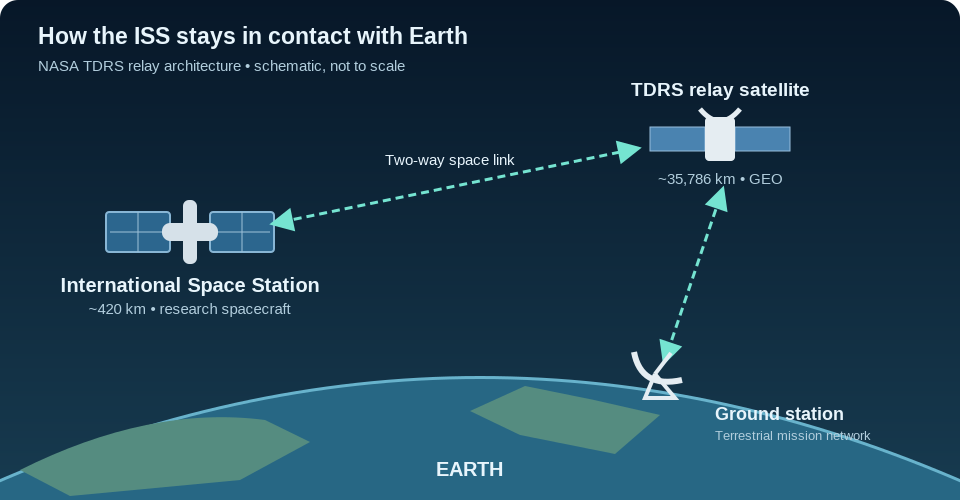
The ISS is not a commercial internet relay. NASA uses geostationary relays and other communications services; the station's amateur radio equipment can also support specialized radio operations. Read the full communications explanation and ARISS beginner guide.
Explore the science
How does the ISS connect to the internet?
Follow data from an orbiting laboratory to Earth and learn why the ISS is not a Starlink relay.
Explore →Why does the ISS not collide with Starlink satellites?
Altitude alone cannot guarantee safety; timing and three-dimensional trajectories matter.
Explore →Can Starlink satellites collide with each other?
How orbital debris and collisions affect the safety of every satellite network.
Explore →Can I communicate with the ISS using ham radio?
A beginner-friendly guide to listening and lawful amateur radio contacts.
Explore →How do satellites communicate with one another?
Explore radio links, optical links, gateways and routing.
Explore →Why do satellites not fall to Earth?
Understand orbital free fall, gravity and speed.
Explore →Why does the ISS need to boost its altitude?
Even space stations encounter traces of atmosphere and need orbital maintenance.
Explore →Can satellites run out of fuel?
Why propulsion, station keeping and mission lifetime matter.
Explore →How are satellites protected from radiation?
Learn what radiation does to spacecraft electronics and why protection is mission-specific.
Explore →Sources and further reading
Public science, agency guidance and official documentation
Explanations are editorial summaries. Calculations and examples are illustrative unless identified as observations. Editorial standards · Suggest a correction.