
SATELLITE INTERNETINSIDERExplore. Discover. Connect.Get Starlink $100 OfferReferral link · We may earn a reward

Home / Knowledge index

Preparedness

Home / Knowledge center

Can Starlink survive an EMP or a major solar storm?

Updated November 24, 2026 · 3 min read (approx.)

My libraryPrinter-friendly view

Separate space weather from electromagnetic pulse risks and design a realistic backup plan.

Beginner’s explanation · November 24, 2026

In this guide

What is it?

An electromagnetic pulse (EMP) is a brief electromagnetic disturbance that can couple into electrical systems. A high-altitude nuclear EMP and a geomagnetic disturbance driven by solar activity are different hazards. The latter is typically slower and especially relevant to long conductors; a rapid EMP can couple to smaller wiring and electronics. Neither label alone predicts the damage to a particular device.

What does the number mean?

There is no meaningful Kp equivalent for a nuclear EMP. Kp describes planetary geomagnetic disturbance over three-hour intervals. EMP assessment instead considers field characteristics, duration, coupling, shielding and system susceptibility. Even Kp 9 does not mean that an EMP occurred, and Kp 0 does not establish that all electromagnetic hazards are absent.

Why should I care?

Satellite service depends on orbiting hardware, ground stations, terminal electronics, local power and terrestrial networking. A hazard that leaves a satellite healthy can still interrupt service on the ground. A portable dish is a useful alternative to a damaged local access network, but it is not an independently guaranteed emergency service.

How does it affect my life?

A practical home plan begins with common hazards: power failure, storms and failed cables. Keep a charged battery, written contact numbers, an alternative communications method and accessible offline information. Follow equipment instructions and official emergency guidance. A conductive enclosure can reduce some electromagnetic coupling, but performance depends on seams, openings and attached cables; no improvised enclosure should be treated as a verified protection rating.

What not to infer

There is no public evidence that a particular retail terminal is guaranteed to operate through every EMP scenario. Do not buy equipment on the assumption that it has such certification. Check the manufacturer’s actual environmental and electrical specifications and use multiple independent options.

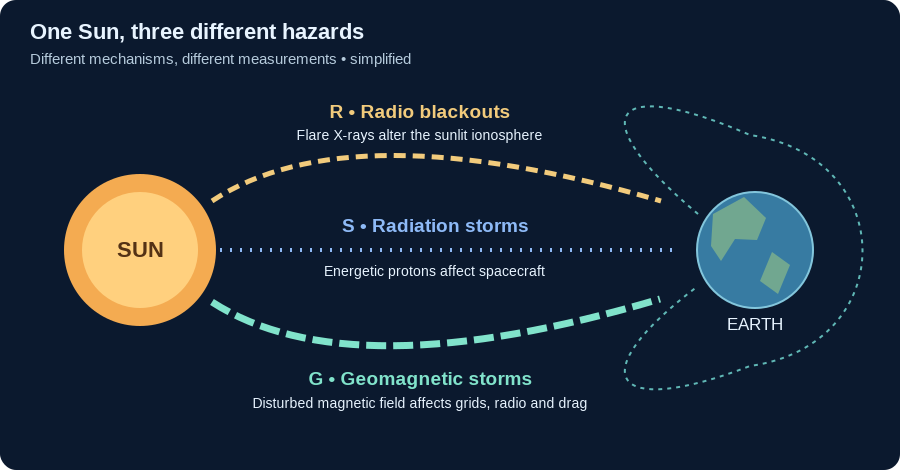
Three space weather hazards: X-rays, energetic protons and magnetic disturbances
Original explanatory schematic. These effects may occur together, but their NOAA scales are separate.

Sources and further reading

Public science, agency guidance and official documentation

Explanations are editorial summaries. Calculations and examples are illustrative unless identified as observations. Editorial standards · Suggest a correction.

In this guide

There is no guarantee of survival

A terminal that tolerates rain and normal electrical conditions is not automatically certified for extreme electromagnetic events. We found no public system-wide guarantee that a consumer Starlink kit would keep providing service after a severe EMP or geomagnetic storm. A working terminal alone is not enough: the constellation, ground infrastructure, account systems, power and internet routing must also work.

Solar flares, geomagnetic storms and EMP are not the same

EventPotential effectImplication
Solar flareChanges to radio propagation and ionospheric conditionsDifferent frequencies and systems are affected differently
Energetic particlesRadiation exposure and electronic upsets in spaceSatellite operations may be affected
Geomagnetic stormGrid disturbances, navigation errors and atmospheric heatingPower and orbit management become important
EMPTransient electrical effects on equipment and infrastructureSurvival depends on exposure, protection and design

NOAA documents separate mechanisms for space weather effects on navigation, satellite drag and electrical grids. A solar storm is not a blanket explanation for every connectivity failure. Local weather and network incidents may be more common causes.

Design for failure, not immunity

Keep a compatible spare power supply and cable, a charged battery, offline maps and contact information. Protect equipment from routine surges using appropriate professionally installed protection. Avoid claiming that an ordinary metal container or surge strip makes a system EMP-proof; verified protection requires specialist engineering.

For life-critical communications, use a layered plan with independent technologies: a battery radio for official alerts, a suitable satellite messaging or emergency device, local communication arrangements and an agreed family meeting plan. Test them regularly and follow instructions from emergency officials.

What about standby subscriptions?

Low-speed standby service may help with routine contingency messages when the network is available. It does not guarantee communication during a major infrastructure event. Test how to resume an eligible active plan before an emergency.

Where to monitor conditions

NOAA's Space Weather Prediction Center publishes space-weather conditions and alerts. These are not a consumer Starlink outage prediction. If normal service stops, check your power source, terminal status and official provider notices before diagnosing a solar event.

Evidence and further reading

Sources are linked to original publishers or identified public records. Plan documents and specifications may change. See the research library for evidence types and limitations.

Continue learning

Independent guide. I may receive a reward if you use my referral link and qualify. Not affiliated with Starlink or SpaceX.

Get Starlink $100 Offer ↗

Eligible new US customers; two full qualifying billing cycles. Terms apply. Not a checkout discount. We may also receive a reward if you qualify. Offer details.

Continue exploring