
1. What makes satellite internet different?
All internet access technologies move packets between your device and the rest of the network. Fiber uses light inside glass, cable uses a coaxial network, cellular uses radio to reach a tower, and satellite uses a radio link to orbit. The final few miles of access infrastructure are different, but each system connects to a wider network of routers, data centers and fiber links. Satellite is valuable because it can serve dispersed locations without building a new wired access network to every property.
A satellite connection is not the same thing as GPS reception. GPS receivers listen to timing signals to calculate location; a broadband terminal must transmit and receive large amounts of data. Nor is satellite internet the same as satellite TV, which is primarily a one-way broadcast to many receivers. Broadband must carry individual requests and responses.
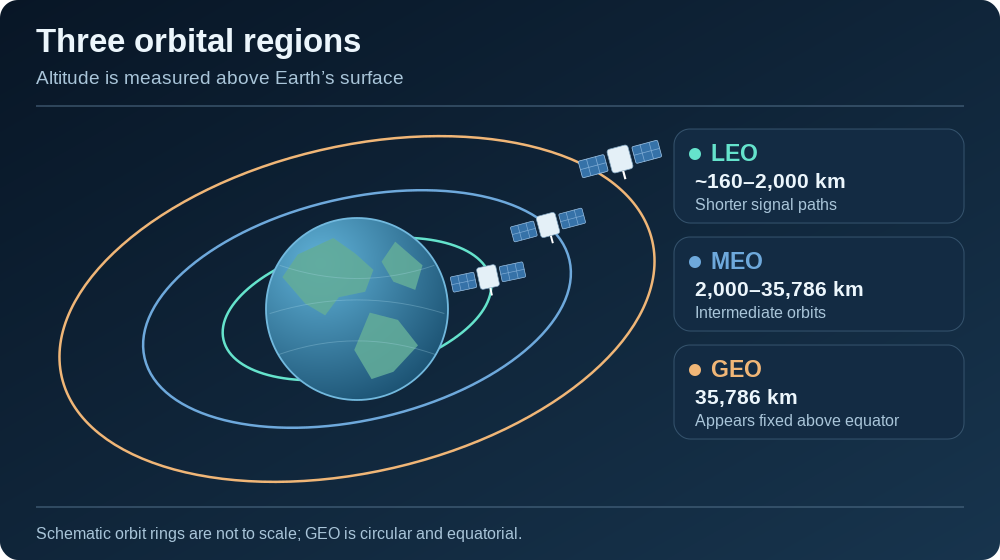
2. Three orbital regimes
| Orbit | Representative altitude | How it behaves | Typical use |
|---|---|---|---|
| LEO | 550 km example; many other shells | Crosses the sky in minutes | Modern broadband constellations, imaging |
| MEO | About 20,200 km for GPS | Longer passes, larger footprints | Navigation and some data networks |
| GEO | 35,786 km above equator | Appears stationary | Broadcasting, broadband and weather |
A GEO satellite matches Earth's rotation when in a circular equatorial orbit. That makes a fixed pointing antenna possible. A LEO satellite moves relative to the user, so service requires tracking and handoffs. The shorter path reduces propagation delay; the trade-off is many satellites and sophisticated network coordination. MEO is an intermediate design choice, not a single fixed altitude.
3. The physics of latency
Light travels in vacuum at approximately 299,792 km per second. For an idealized bent-pipe connection with a user and gateway directly below a satellite at altitude h, the round trip is four times h. At 550 km, 2,200 km divided by the speed of light gives about 7.3 ms. At 35,786 km, the result is about 477 ms. Real paths are slanted and include processing, queues, routing and possibly other satellites; these figures are physical lower-bound examples, not measured ping claims.
Bandwidth and latency solve different problems. A large pipe can deliver many bits per second yet have a long response time. Streaming services can buffer data in advance, while a live voice conversation cannot buffer several seconds without becoming awkward. Interactive games and remote desktops may suffer from jitter or packet loss even when the reported Mbps is high. Choose a technology based on the most demanding workload you actually use.
4. What the infrastructure looks like
The user terminal communicates with a spacecraft through a directed radio beam. Gateways connect satellites to the terrestrial network. Some constellations also route data through optical links between satellites, which can extend the path to a distant gateway. An internet exchange or other interconnection point forwards packets toward their destination. Operators manage routing, spectrum, capacity, billing and software updates, all of which can influence performance.
A satellite may cover a region larger than a city but cannot provide infinite bandwidth to it. Operators divide coverage into beams and reuse frequencies where interference can be controlled. Scheduling shares resources among users. A dense cluster of users in one service region can produce congestion even when the sky is completely clear. More satellites can improve capacity and coverage, but the effect depends on deployment, spectrum, routing, hardware and demand.
5. Compare alternatives honestly
| Technology | Principal advantage | Principal constraint |
|---|---|---|
| Fiber | Often excellent capacity and latency | Build-out cost and availability |
| Cable | Widespread residential access | Shared local infrastructure, upload profile varies |
| Fixed cellular | Quick setup with tower coverage | Indoor signal, congestion, tower/backhaul power |
| LEO satellite | Rural reach and portability with compatible plans | Sky visibility, service capacity and power |
| GEO satellite | Established fixed-dish service | Longer physical propagation delay |
Do not choose by a nationwide speed ranking alone. Obtain an address-specific quote and compare data policies and expected evening performance. The FCC map can identify reported fixed and mobile options in the United States, but reported availability is not a measured guarantee. If you can use a reliable wired primary connection, satellite may still be a useful secondary path rather than a replacement.
6. Why geography and weather matter
A mountain ridge, dense forest, roof or tall building can remove useful signal directions. Trees are especially variable because leaves, water content and wind change over time. Rain and snow can weaken some radio links and accumulated snow may obstruct a terminal. A terminal advertised for outdoor use still requires its seals, connectors and mount to be installed correctly.
Geographic reach is different from permission to provide service. A satellite might be visible over a country where an operator has no authorization, and a gateway or routing limitation may restrict practical coverage. Before carrying equipment abroad, check the destination's telecommunications and customs rules, account plan, and provider map.
7. The economics of deployment
A wired operator may spend heavily on trenches, poles and drop cables, but capacity can be excellent once installed. A satellite operator spends on spacecraft, launches, spectrum rights, ground stations, terminals and replacement spacecraft. Its marginal cost of reaching another rural location may be attractive where the network already has coverage, but serving dense cities still faces finite radio capacity. Neither architecture eliminates operating costs.
For consumers, compare a common time horizon: upfront equipment plus twelve months of service, installation, data fees and electricity. Then consider future costs after introductory offers. A lower advertised monthly price can be outweighed by equipment costs or a contract. For a backup connection, compare the cost with the consequences of downtime rather than just the speed per dollar.
8. Reliability and measurement
Run multiple measurements on different days. Record download, upload, median latency, a high-percentile latency, interruptions and packet loss. Keep the test device and connection method consistent. A household that streams movies may tolerate a few brief drops while a business using real-time telemetry may not. Reliability is workload-specific. For a critical use case, maintain redundancy and test failure recovery deliberately under safe conditions.
A useful log includes the timestamp, terminal model, plan, weather, sky obstruction, router connection, test server, and power method. Report failed attempts, not just best results. Avoid generalizing from one short test or a provider-selected demonstration. See the measurement database for a repeatable method.
9. Where satellite fits in the future
The industry includes fixed broadband, mobile voice, maritime and aviation internet, low-power IoT and direct-to-device messaging. These services use different antennas, frequencies and capacity models. A smartphone connecting to a satellite for a short text does not automatically offer the same data rate as a dedicated broadband terminal. The provider guide separates these categories so buyers compare like with like.
Orbital congestion, radio interference, astronomy and atmospheric reentry are important constraints on future growth. Engineering trade-offs include the choice of altitude, end-of-life disposal, maneuverability and optical brightness. See the environment guide for evidence and uncertainty.
10. What should I do next?
If you are researching a purchase, begin with the address, intended use, monthly data needs and acceptable interruption time. Use the comparison guide to shortlist service types, then check offers from the appropriate providers. If you want to understand the science, follow the engineering reference to learn how antennas, spectrum and routing work. If you are preparing for emergencies, start with the communication plan and power budget rather than the fastest headline speed.
11. Worked example: the same house with different access options
Consider a rural house with a fixed wired quote of $70 per month and $300 installation, a cellular quote of $60 per month and $150 equipment, and a satellite quote of $90 per month and $249 hardware. Before taxes and extra charges these hypothetical first-year totals are $1,140, $870 and $1,329. The cellular quote appears cheapest, but if its evening upload is too weak for remote work the lower cost may not deliver the required outcome. If the wired connection has a consistently good upload and acceptable reliability, it may be the better primary service even when the satellite connection advertises a higher peak download.
Now suppose the household values continuity during local infrastructure outages. A second connection may be justified independently of which primary connection wins. A backup path should avoid the same failure domain: two cable brands could share a physical line, and two cellular services may share a tower or regional backhaul. Satellite adds a different last-mile path, but the house still needs independent power and the satellite network still needs functioning ground interconnection. Evaluate a combined architecture rather than ranking individual providers in isolation.
12. Capacity, data use and quality of service
An application consuming 5 Mbps continuously for one hour transfers about 2.25 GB in decimal units, excluding overhead. Four hours per day for 30 days consumes roughly 270 GB. This is an illustrative bitrate rather than a streaming platform guarantee. Adaptive streaming changes bitrate, downloads and cloud backups add traffic, and some plans have separate high-speed allowances. A family can use the same internet service very differently depending on the number of simultaneous streams and whether devices update automatically.
Quality-of-service policies can prioritize latency-sensitive traffic within your own router, but they cannot create capacity that does not exist. If a cloud backup saturates the uplink, restricting its rate may improve calls. If the satellite access path itself is congested, local scheduling has limited influence. Distinguish bandwidth management at home from network priority at the provider.
13. Service evaluation checklist
Create a small test plan before choosing a provider. First, verify the address and quote; second, identify a safe installation location; third, determine whether a return or trial policy applies; fourth, test actual workloads; finally, document power and failover. Compare morning, midday and evening measurements rather than comparing a maximum result from one technology with a minimum result from another. Keep the same device and test service when possible, and report unusual weather or outages. For a household that depends on internet access for essential work, assess alternate connection methods before cancelling the primary service.