
Starlink and partial obstructions: what has changed?
Updated November 23, 2026 · 4 min read (approx.)
Starlink advertises improved connectivity around partial obstructions, citing 11,000 satellites in a November 2026 advertisement supplied to our editorial desk. This is a dated company claim, not a verified operational count or a guarantee at your address.

In this guide
- Why more satellites matter
- What still blocks service
- Before you buy
- Useful next steps
- Three practical categories of sky visibility
- From a satellite count to an individual link
- Measure the difference that matters
- Evidence and further reading
- Related questions and next steps
- Official resources
- What independent experiments actually found
Why more satellites matter
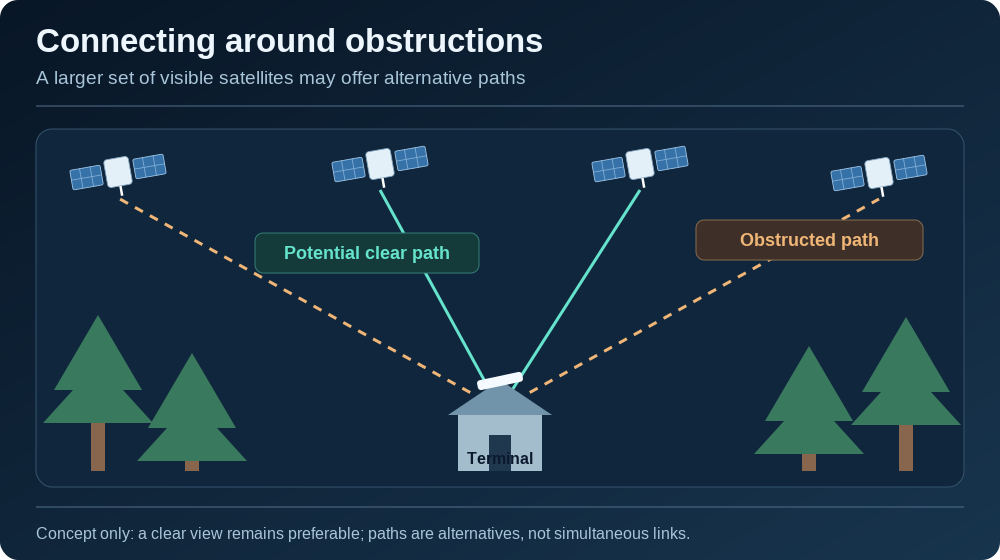
A moving constellation can offer alternative paths around obstacles when geometry and available network capacity permit. The terminal can switch satellites; this does not mean it uses every visible satellite at once.
What still blocks service
Dense overhead foliage, roofs and steep terrain can eliminate usable paths. A brief dropout can interrupt a VPN or video call even when average download speed looks excellent.
Before you buy
Scan at the intended mounting position using the Starlink app. Compare a clearing with the proposed roof or pole location, including summer foliage. Use the suitability checker below and consult an installer if elevated mounting is needed.
Useful next steps
Installation suitability checker · Cost calculator · Wooded properties · Buying checklist
Reference guide · Updated November 24, 2026
Three practical categories of sky visibility
| Sky view | Likely concern | Next action |
|---|---|---|
| Open sky | Network demand or other issues may still affect service | Baseline performance test |
| One or more partial obstacles | Some satellite paths blocked, alternate paths may exist | Scan exact position and monitor outages |
| Dense overhead canopy or roof | Many possible paths blocked | Choose a clearer safe site; do not assume improved routing will solve it |
From a satellite count to an individual link
The number of spacecraft globally is not the number a particular terminal can use. Orbital geometry, elevation, regulatory constraints, scheduling, capacity and link quality all restrict the available candidates. A denser constellation may give more opportunities to select a clear path, but it cannot transmit through every opaque obstacle. The research demonstrates adaptation rather than immunity.
Measure the difference that matters
For a backup system, a short delay might be tolerable for text messages. For remote work, repeated interruptions may be unacceptable. Compare your actual application experience and interruption history, not just a favorable download test. A clear site is still the preferred installation whenever practical.
Evidence and further reading
- Kataria et al., What Obstructed Skies Teach Us About Satellite Internet (2026) Independent research
Controlled obstructions and evidence of satellite selection adapting to blockages; not a universal outage forecast.
- Starlink: Prepare for install and select a location Manufacturer guidance
Sky visibility, mounting and siting guidance.
- Starlink: Checking obstructions Manufacturer guidance
Pre-install scanning and observed obstruction maps are different measurements.
- Mohan et al., A Multifaceted Look at Starlink Performance (2024) Independent research
Crowdsourced tests, application performance and controlled measurements of temporal variability.
Sources are linked to original publishers or identified public records. Plan documents and specifications may change. See the research library for evidence types and limitations.
Official resources
What independent experiments actually found
A 2026 controlled network experiment compared obstructed and unobstructed terminals. The authors observed alternate satellite selection and evidence of adaptive switching within the usual handover interval. They also measured residual latency and packet-loss penalties. That supports the mechanism, not a promise that every wooded property will work.
SpaceX reported more than 11,000 satellites in orbit on October 6, 2026. The number in the entire constellation is not the number available to one dish: horizon geometry, assigned beams, capacity and obstructions determine usable paths.
What to measure at your own property
Compare outage duration, packet loss and call quality at two locations over at least a day. A high peak speed can hide brief dropouts. Start with the app scan; inspect the actual obstruction map once the terminal has learned its surroundings.
Check your installation conditions · Read the research news feature.
Sources and further reading
Check availability and current pricing
Independent guide. We may receive a reward if you qualify through our link.
Get Starlink $100 Offer ↗Eligible new US customers; two full qualifying billing cycles. Terms apply. Not a checkout discount. We may also receive a reward if you qualify. Offer details.