
Starlink around trees: the science behind improved satellite coverage
Source event / publication: 2026-11-24 · Updated: November 24, 2026 · 3 min read (approx.)
A growing constellation and adaptive switching can make partially obstructed sites more practical, but a clear sky still matters.

In this guide
What has changed?
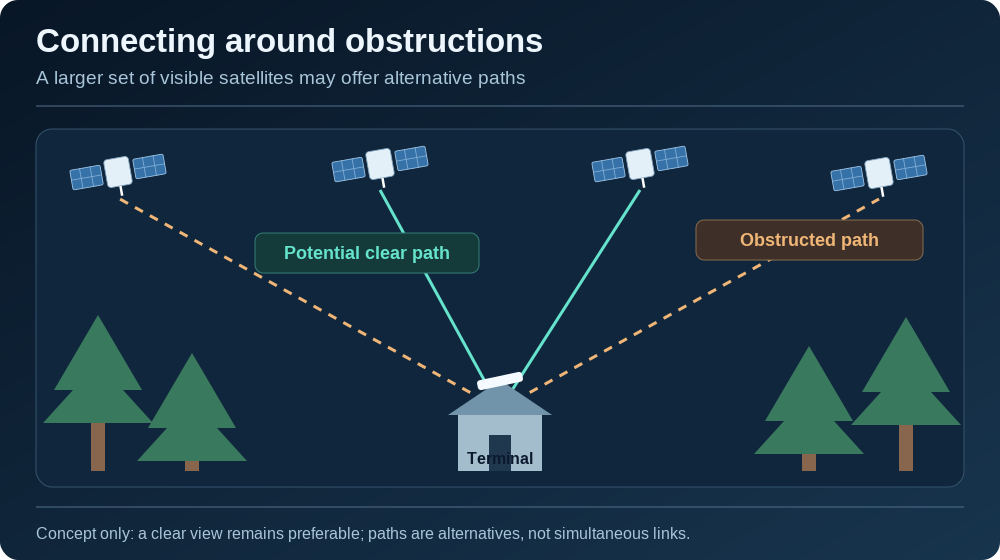
In a November advertisement, Starlink highlighted its ability to find connections from different angles. Its October 6 update reported more than 11,000 satellites in low Earth orbit. Its support guidance describes automatic switching when a path is blocked.
Independent evidence
Researchers reporting at NINeS in 2026 experimentally introduced obstructions and observed the terminal choosing alternative satellites. They also measured increased latency and packet loss. A different IEEE field experiment found that overhead bridges disrupted moving terminals. These studies support a nuanced conclusion: some partial blockages can be routed around, but full blockages remain a problem.
What this means for you
Try a scan at the exact installation point and compare outage history before committing to a permanent mount. Use our suitability checker and read the wooded-property guide.
Sources and further reading
- SpaceX / Starlink updates, October 6, 2026
- Starlink: how obstructions affect a connection
- What Obstructed Skies Teach Us About Satellite Internet (NINeS, 2026)
- Measuring Mobile Starlink Performance (IEEE, February 2025)
Back to all news and research →
Reference guide · Updated November 24, 2026
What the experiment measured
The independent NINeS paper used repeatable physical blockage experiments rather than simply collecting customer testimonials. In that setup, obstructed terminals sometimes chose a different satellite from a comparison terminal, and the researchers observed evidence of adaptive routing within ordinary handover intervals. Average latency and packet loss also increased. The central finding is that routing can adapt, not that all blockages are harmless.
Why the result matters to a buyer
A property once considered too difficult because of trees may be worth re-evaluating with the app. However, the study is not a map of your property and its average effects are not guarantees. Use the installation checker, compare clear and obstructed sites and measure real application interruptions. See the research library for the paper's publication and limitations.
Evidence and further reading
- Kataria et al., What Obstructed Skies Teach Us About Satellite Internet (2026) Independent research
Controlled obstructions and evidence of satellite selection adapting to blockages; not a universal outage forecast.
- Starlink: Prepare for install and select a location Manufacturer guidance
Sky visibility, mounting and siting guidance.
- Starlink: Checking obstructions Manufacturer guidance
Pre-install scanning and observed obstruction maps are different measurements.
Sources are linked to original publishers or identified public records. Plan documents and specifications may change. See the research library for evidence types and limitations.