
Starlink mounting locations: ground, pole, roof and more
Updated November 23, 2026 · 3 min read (approx.)
The best mount balances sky access, safe installation, maintenance and cable routing.
In this guide
- Ground or patio
- Pole or roof
- Avoid improvised locations
- Useful next steps
- Unconventional positions require ordinary engineering checks
- Before choosing an unusual mount
- Commission the final position
- Evidence and further reading
- Related questions and next steps
- Official resources
- Mounting near rooftop equipment and other unusual locations
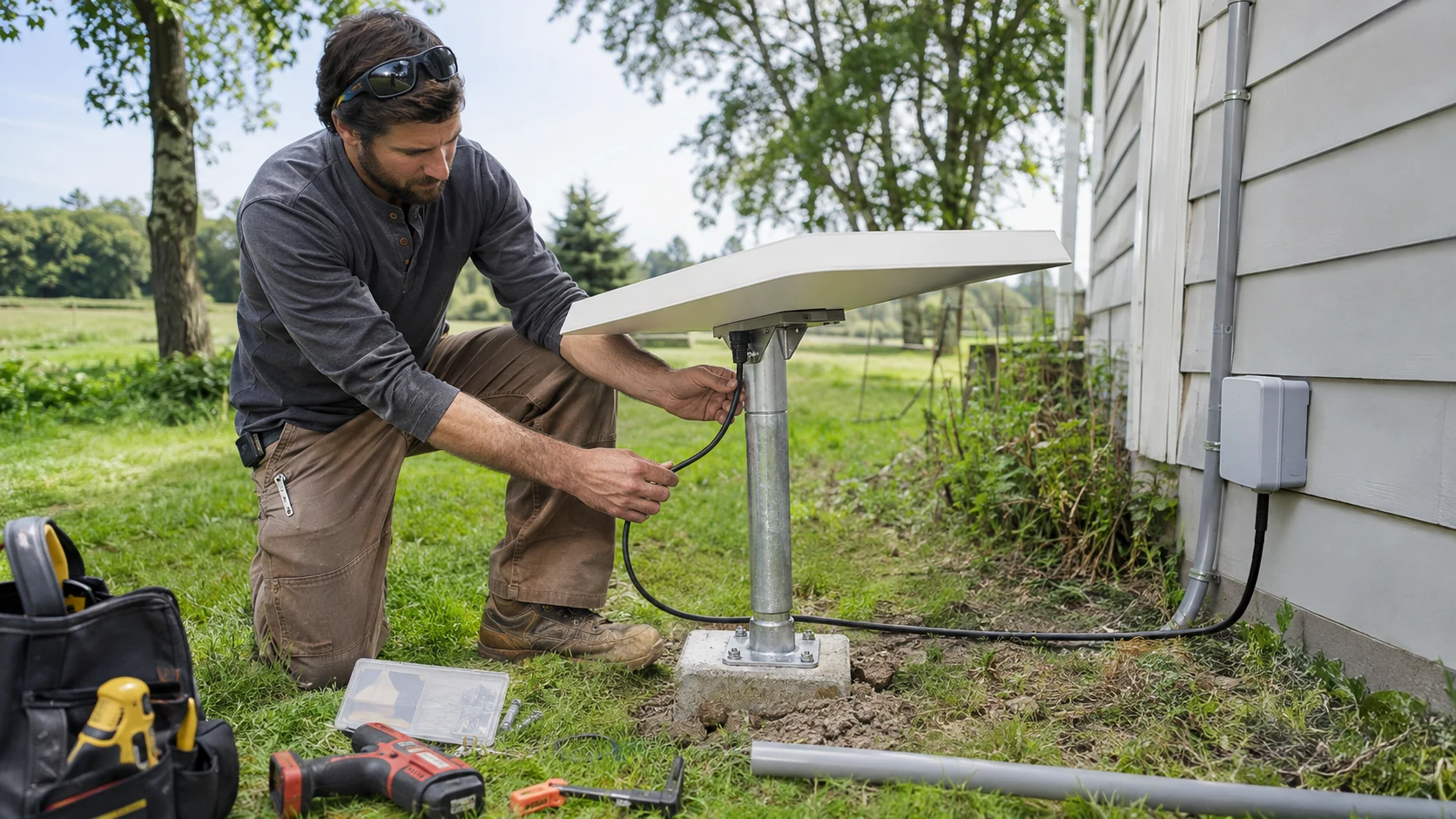
Ground or patio
Useful for temporary tests; secure equipment against movement and keep it clear of people, pets and vehicles.
Pole or roof
Can improve sky visibility but requires compatible hardware, wind-load considerations and safe professional installation when necessary.
Avoid improvised locations
Do not place equipment where HVAC exhaust, heat, service access, moving machinery or roof drainage can create hazards.
Useful next steps
Installation suitability checker · Cost calculator · Wooded properties · Buying checklist
Reference guide · Updated November 24, 2026
Unconventional positions require ordinary engineering checks
A roof near HVAC equipment, a deck railing or a pole may provide useful sky visibility. A photograph of a working dish near an air-conditioning unit does not mean every such site is suitable. Metal structures can obstruct part of the sky; exhaust heat, vibration, service access and wind exposure can affect reliability and safety.
Before choosing an unusual mount
| Location | Check |
|---|---|
| Near rooftop HVAC | Required clearances, maintenance access, heat and airflow |
| Wall/eave | Roof and wall obstruction, rated fasteners |
| Ground pad | Drainage, mowing, snow and trip hazards |
| Pole or mast | Wind loading, structural strength, cable support |
Do not attach the terminal to unrelated equipment unless the equipment and mounting design allow it. Follow local building, electrical and workplace requirements; seek a professional for elevated or commercial installations.
Commission the final position
Compare the obstruction scan and actual terminal statistics, inspect cable protection and verify that all maintenance access remains clear. A temporary test is valuable before committing to permanent construction.
Evidence and further reading
- Starlink: Prepare for install and select a location Manufacturer guidance
Sky visibility, mounting and siting guidance.
- Starlink equipment specifications Manufacturer specification
Model-specific environmental, electrical and mounting specifications.
- Starlink: Checking obstructions Manufacturer guidance
Pre-install scanning and observed obstruction maps are different measurements.
Sources are linked to original publishers or identified public records. Plan documents and specifications may change. See the research library for evidence types and limitations.
Official resources
Mounting near rooftop equipment and other unusual locations
A clear patch between HVAC units is not necessarily a clear field of view. Tall units, parapets and metallic structures can block satellite paths. Check the intended dish height and orientation in the app and leave service access, airflow, drainage and clearances intact.
A post, suitable wall bracket or roof mount can improve visibility; use equipment approved for the model and site. A qualified installer should evaluate roof penetrations, wind loading, lightning protection and separation from electrical equipment. Do not attach to an HVAC housing or exhaust vent.
Sources and further reading
Check availability and current pricing
Independent guide. We may receive a reward if you qualify through our link.
Get Starlink $100 Offer ↗Eligible new US customers; two full qualifying billing cycles. Terms apply. Not a checkout discount. We may also receive a reward if you qualify. Offer details.