
Home / Space science & communications
How does the ISS connect to the internet?
Updated November 24, 2026 · Satellite Internet Insider editorial desk
Follow data from an orbiting laboratory to Earth and learn why the ISS is not a Starlink relay.
In this guide
What is it?
The International Space Station is an artificial satellite and a research laboratory. It is a spacecraft that uses communications networks to exchange mission data, voice, video and science information with Earth. It is not a node of a commercial satellite broadband constellation.
What do the numbers mean?
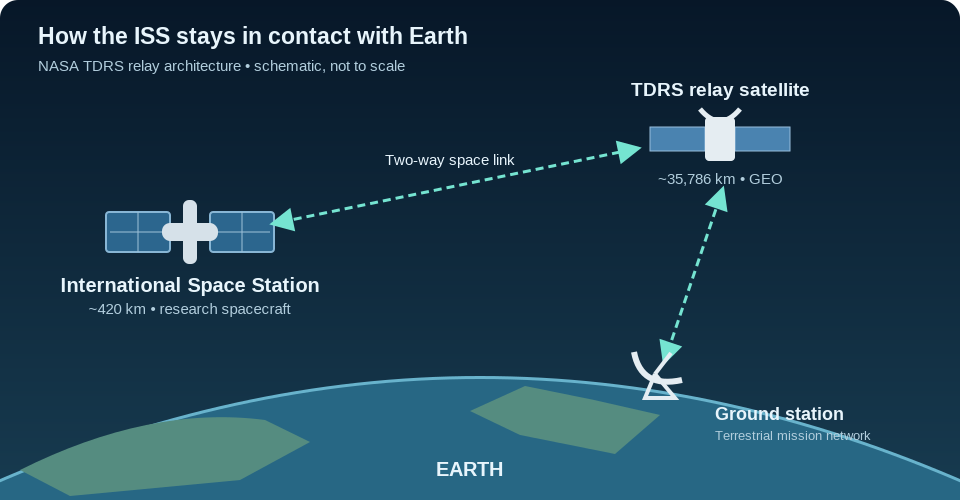
The station normally orbits a few hundred kilometers above Earth; NASA’s reference gives a range of 370–460 km. NASA’s Tracking and Data Relay Satellites (TDRS) operate near geostationary altitude, approximately 35,786 km. A relay far above Earth can see a much larger region than a spacecraft in low orbit. Distance adds signal travel time, so high coverage and low delay are different design goals.
Why should I care?
A station at low altitude quickly moves beyond any individual ground antenna’s horizon. NASA’s relay architecture provides broad contact by passing information between spacecraft and terrestrial facilities. NASA has also demonstrated optical relay technologies, including an ISS-associated experiment. This does not imply that the station routinely relays Starlink customer traffic.
How does it affect my life?
The same basic network concepts explain satellite broadband: a local terminal talks to a spacecraft, data is routed onward to a gateway or via other satellites, and the ground network connects to the destination. Loss of one component can disrupt the entire path. The exact architecture differs by mission and provider.
A second role: amateur radio
The ISS also carries amateur radio equipment that may support educational contacts and cross-band repeater operation when configured and available. That is a specialized radio service, not a commercial broadband relay. See the ARISS guide and verify the current operating mode before attempting any contact.
Sources and further reading
Public science, agency guidance and official documentation
- NASA TDRS overview
- NASA ISS reference
- NASA optical communications demonstrations
- ARISS contact information
Explanations are editorial summaries. Calculations and examples are illustrative unless identified as observations. Editorial standards · Suggest a correction.