
1. Start with a service requirement, not a solar panel
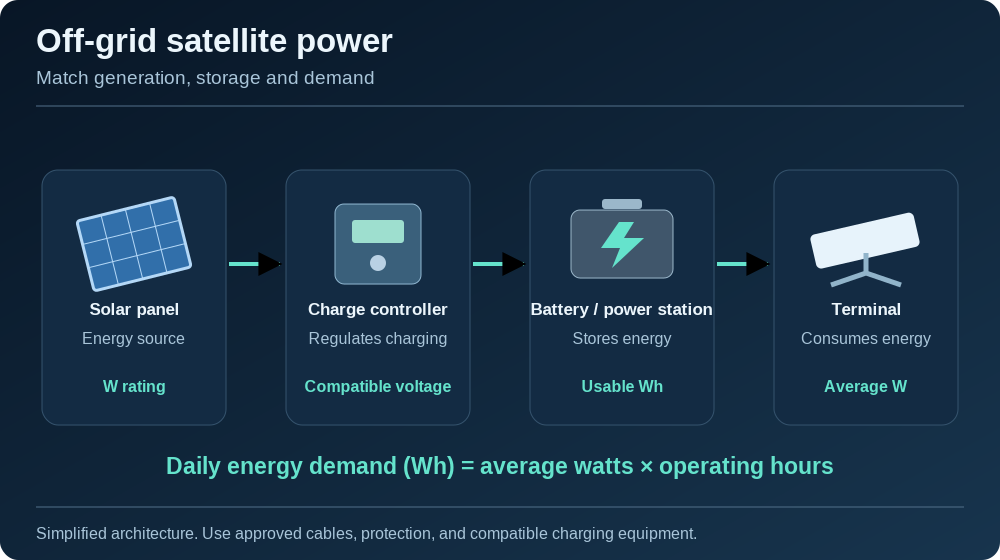
Off-grid internet is a system with at least four pieces: a connection, a terminal, local networking and an energy source. Establish how many hours the connection must run and which tasks cannot be deferred. A weekend campsite may need a few hours for messages; a remote worker may need eight reliable hours plus charging for a laptop; a household backup may need short check-in windows for several days. Continuous operation is much more demanding than scheduled operation.
List every electrical load separately, including router, terminal, phone charging, laptop, inverter and monitoring device. Avoid adding a terminal's power rating as though it were always its average draw; measure average consumption under normal traffic, while ensuring the power system can supply required peaks. Manufacturer specifications are a starting range, not a guarantee.
2. Watts, watt-hours and amp-hours
Watts measure instantaneous power. Watt-hours measure energy over time: watts multiplied by hours. A 30 W load running for six hours uses 180 Wh. Amp-hours alone are not enough to compare batteries unless voltage is known; a nominal 12 V, 50 Ah battery is 600 Wh nominal. Usable energy may be lower because of allowable depth of discharge, temperature and conversion losses.
Distinguish three battery limits: stored energy, maximum continuous output and peak/surge capability. A large battery can still be incompatible with a required USB Power Delivery voltage profile. For Starlink Mini, use the approved 100 W USB-C PD source and appropriate cable if using that method; confirm the DC input requirements separately. Avoid modifying a power system without suitable electrical competence.
3. Compute a realistic daily energy budget
Scroll horizontally to compare all columns.
| Load | Example watts | Hours/day | Energy/day |
|---|---|---|---|
| Mini | 30 | 8 | 240 Wh |
| Laptop | 45 | 4 | 180 Wh |
| Phone charging | 10 | 2 | 20 Wh |
| Additional router | 8 | 8 | 64 Wh |
| Total | 504 Wh |
At 85% usable system energy, one day of this illustrative load needs roughly 593 Wh of rated capacity. Two days without recharging need about 1,186 Wh, or roughly 1,483 Wh with 25% reserve. If you do not need the additional router, omit it; if the inverter consumes energy while idle, add it. These examples use an aggregate efficiency assumption, so do not separately count losses that are already included.
4. Size the solar array
A nominal solar panel rating is measured in standardized test conditions, not a daily output promise. Approximate daily harvest with panel watts multiplied by local peak-sun-hours and a derating factor. A 200 W panel at four peak-sun-hours with 75% net efficiency yields about 600 Wh/day in this example. That is barely sufficient for the 504 Wh load before reserve and unfavorable days; at two sun-hours it yields about 300 Wh, creating a deficit.
Peak-sun-hours represent equivalent hours at reference irradiance, not the time between sunrise and sunset. Roof orientation, shade, temperature, weather, latitude and charge-controller behavior matter. Use PVWatts or local solar data for site-specific estimates. PVWatts primarily models PV system production, not the complete behavior of your portable battery. Validate your actual harvest using a meter. Plan for winter and cloudy days instead of summer averages.
Scroll horizontally to compare all columns.
| Example daily load | Peak sun hours | Derating | Approximate array before reserve |
|---|---|---|---|
| 180 Wh | 4 | 75% | 60 W |
| 504 Wh | 4 | 75% | 168 W |
| 504 Wh | 2 | 75% | 336 W |
| 720 Wh | 2 | 75% | 480 W |
The array must also remain within the controller's voltage, current and power limits under expected temperatures. Do not exceed equipment ratings or connect panels in a configuration the manufacturer does not support. For fixed electrical installations, use appropriately qualified help.
5. Choose AC or DC intelligently
Using the supplied AC adapter and a portable station's inverter is often the simplest setup. It may waste energy converting battery DC into AC and back into DC, and an inverter can consume power even when the terminal is idle. A compatible direct DC or USB-C supply may reduce conversion losses. The efficiency difference is equipment-specific; compare actual measured watt-hours at the battery output. Do not bypass protective devices to save energy.
Check both output and input capabilities of the power station: charging speed from solar, whether it supports charging and powering loads simultaneously, temperature limits and low-load auto-shutoff. A power station designed for portable use is not automatically a certified whole-home UPS. Test a transfer under noncritical conditions before trusting it for work or security equipment.
6. Use duty cycles and energy reserves
A Mini drawing 30 W for 24 hours consumes 720 Wh per day; eight hours consumes 240 Wh. During a long outage, scheduled check-in windows can triple runtime relative to continuous operation, excluding startup and other loads. Preserve capacity for essential messages, and avoid leaving an unnecessary inverter running. Write down a minimum battery state at which you switch to lower-energy communications, and reserve a separate method for emergency alerts.
| Situation | Example operating policy |
|---|---|
| Primary remote work | Continuous during work, recharge each day |
| Weekend camping | Morning and evening check-ins plus planned tasks |
| Long grid outage | Short scheduled check-ins, prioritize essential traffic |
| Cloudy forecast | Reduce duty cycle and use alternate charging if safe |
7. Weather and safety
Lithium batteries have charging and operating temperature limits; keep them in a suitable protected location and follow the manufacturer's guidance. Do not charge a battery outside its allowed temperature range. Keep connectors dry and inspect for damage. Secure panels against wind and avoid deployment in hazardous weather. Never use generators inside a house, garage or enclosed shelter, and avoid unapproved backfeeding of house wiring. A prepared system should be easy to use safely, not dependent on complicated improvisation in a crisis.
8. Measure and improve the system
Measure battery output energy over a normal day. Record actual panel harvest, charge percentage, ambient temperature, terminal uptime and workload. If the battery drains unexpectedly, inspect inverter idle draw, other equipment, cold-temperature losses and shade. Change one variable at a time, such as the power path or duty cycle. Repeat tests with similar starting charge and traffic. Publish measurements with context, not a single universal runtime claim.
9. Practical examples
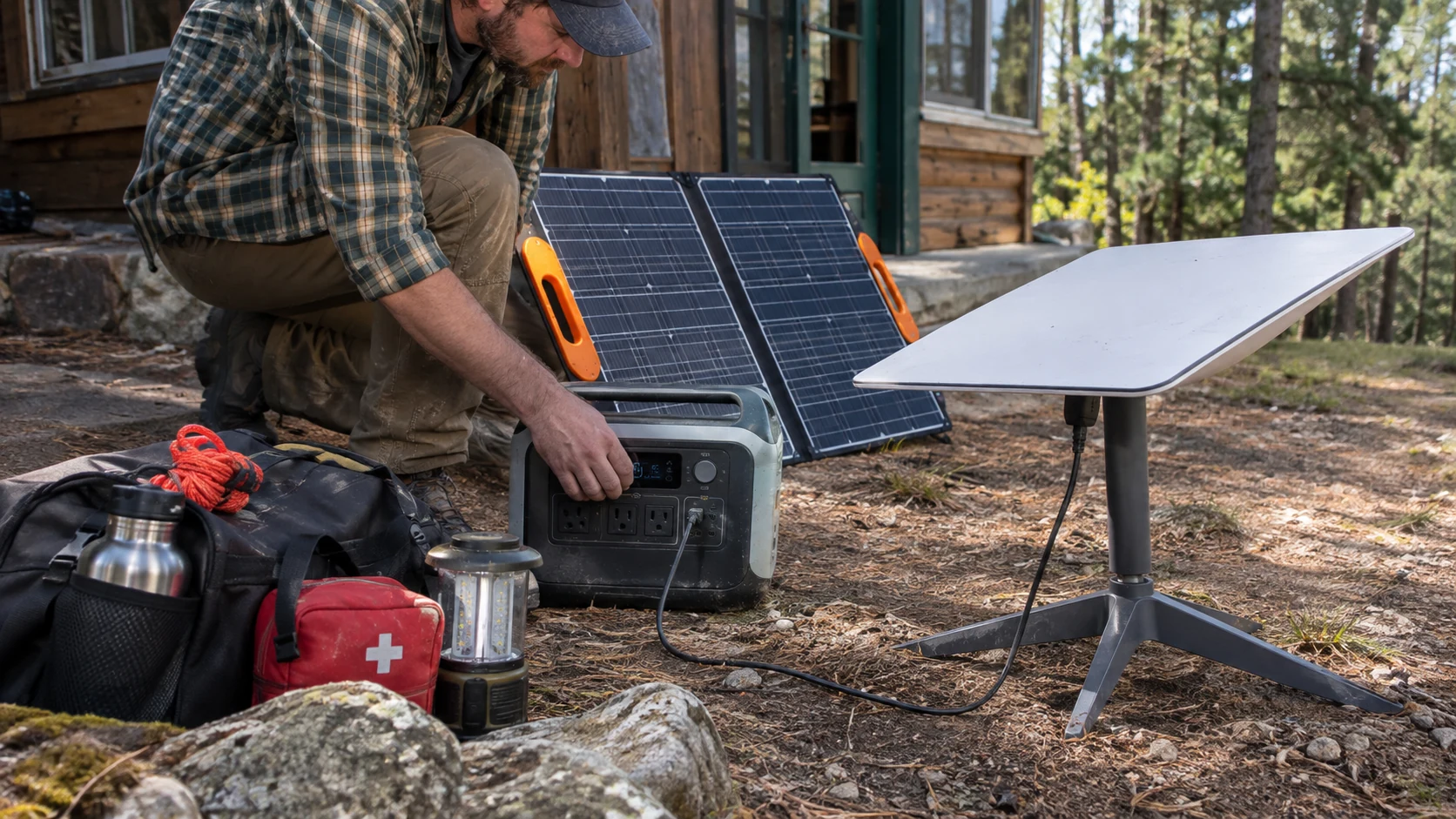
A hiker with a small messenger and a phone needs a very different battery from a family with a satellite dish and laptops. A cabin with reliable sunlight may prefer fixed solar plus a battery bank, while an RV may combine compatible vehicle charging and solar. A homeowner preparing for a short outage might simply keep a charged portable power station. Start with the smallest system that meets the requirement and expand only when measured needs justify it. Use the power tools and the new energy-budget planner below.
10. Three practical configurations
Portable emergency setup. Use the terminal, approved cable and a compatible charged power station, stored together. Size it for a short planned internet window rather than an entire house load. Keep a separate phone power bank and a printed setup guide. If AC output is the only approved practical path, allow for inverter idle draw. Record how long setup actually takes. Avoid putting the equipment outdoors before a weather hazard has passed.
Seasonal cabin. Determine whether the cabin has occasional utility power, a fixed solar system or neither. Include the router, security devices and other communications loads in the energy budget. If internet is required continuously for remote monitoring, calculate worst-season daily energy and battery autonomy rather than assuming a small camping panel will suffice. Consider an appropriately installed power system, overcurrent protection and maintenance access. Ask a qualified installer to assess permanent wiring and battery placement.
Mobile office. A vehicle may offer compatible charging while traveling, but accessory outlets have limits and vehicle starting batteries should not be depleted unexpectedly. Use the approved power accessories, confirm the vehicle and terminal's supported use, and do not improvise wiring. For parked operation, use a portable battery and test the actual supply. Separate a driving safety decision from a connectivity decision: avoid adjustments while moving and do not obstruct visibility or safety equipment.
11. Quantify the cost of wasted energy
Suppose an inverter adds 8 W continuously while the Mini is in use for eight hours. That is 64 Wh per day, compared with the 240 Wh dish load at 30 W. If an appropriately compatible DC path removes most of that overhead, the change could be meaningful for a small battery. The actual savings depend on both converters and their efficiency curves. Measure energy at the same point in each test, keep workloads similar, and avoid comparing an AC-input reading with a battery-output reading as though they are identical.
12. Build a bad-weather reserve rather than an average-day system
For a 504 Wh daily load and a 200 W panel, a two peak-sun-hour day with 75% derating yields 300 Wh. The resulting 204 Wh deficit must come from storage. Two such days require roughly 408 Wh of extra usable battery energy. A larger array, more storage or reduced usage can address the deficit, but only a real site estimate establishes a reasonable starting point. A shaded winter location may produce much less than a sunny summer location. Plan to reduce nonessential loads and preserve a safety reserve before the battery reaches its lower limit.